
The Day a Family Lost Everything — And Then Lost Again
Imagine this.
Your husband wakes up every morning for 14 years. He puts on his uniform. He travels to work on a government contract, earning a modest wage. He does not complain. He serves silently. He dreams that one day, his service will be regularised.
Then one day — he does not come home.
He dies in service. No pension. No gratuity. No security.
You, a widow, uneducated, with children to feed, walk into a government office with trembling hands and beg for a job. They take pity. They give you work. You serve for 15 more years — faithfully, quietly, gratefully.
And then, one November morning in 2020, a single order is passed. “Your services are no longer required.”
This is not fiction. This is the real story of Smt. Harvati and two other widows from Uttar Pradesh — whose lives the Allahabad High Court refused to let be erased.
This is the story of compassionate appointment in India.
What Is Compassionate Appointment?
Compassionate appointment is a legal provision that allows a dependent family member of a deceased government employee to be appointed to a government post — without the regular competitive process.
The purpose is simple and deeply human.
When a government servant dies while in service, the family is left without income, without support, often without hope. Compassionate appointment steps in as an emergency lifeline — not a reward, but a rescue.
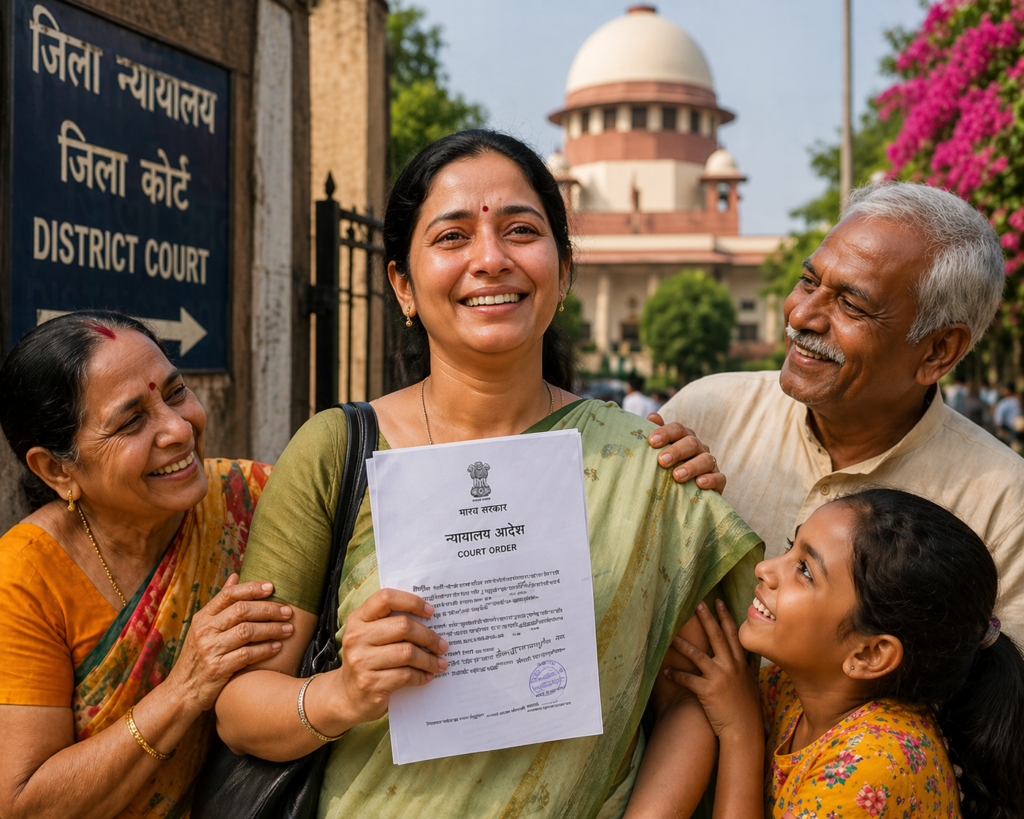
In India, this scheme operates primarily under the Dying-in-Harness Rules, 1974, along with state-level policies adopted by various government corporations and departments.
The key beneficiaries include:
- Spouse of the deceased government employee
- Son or unmarried daughter
- Other financially dependent family members (subject to policy)
Compassionate appointment is not a vested right in the traditional sense. But as India’s courts have repeatedly held, once granted, it cannot be snatched away arbitrarily.
The Legal Foundation: Dying-in-Harness Rules, 1974
The Dying-in-Harness Rules, 1974 form the backbone of compassionate appointment law in India.
Under Section 2(a) of these Rules, a “government servant” is defined specifically. This definition becomes critical because it determines who qualifies for compassionate appointment.
Historically, there was a dispute: do work-charged employees (those employed on specific works rather than permanent posts) fall within this definition?
The respondents in the Harvati case argued they do not. The Allahabad High Court disagreed — and for very good reason.
Even if the husbands of the petitioners were technically work-charged employees, the Court found that the substance of their employment — over 10 to 15 years of continuous service — could not simply be brushed aside.
The law must serve justice. It cannot become a weapon of exploitation.
The Harvati Judgment: A Story Courts Will Not Forget
In Writ Petition No. 3151 of 2021 decided on 28 September 2021, Justice Pankaj Bhatia of the Allahabad High Court delivered a landmark ruling.
The facts were undeniable:
- Three widows whose husbands served as work-charged employees from 1990–1994
- Husbands died in service in 2004 and 2005
- Widows were given employment on compassionate grounds, paid consolidated wages of ₹18,000 per month
- They served faithfully for over 15 years
- On 9 November 2020, a single order ended their employment — reason given: “services no longer required”
The State argued these women had no legal right. Their husbands were not “government servants.” Their appointments were merely acts of mercy.
The Court was unmoved by this argument.
Justice Bhatia held that the dismissal order was “wholly arbitrary and illegal.” He quashed it. He directed the Corporation to absorb the petitioners and consider their regularisation.
The State, he said, cannot act as a model employer on paper while practicing exploitation in reality.
Compassionate Appointment Must Be on Regular Pay Scale
One of the most important legal developments in this area came from another Allahabad High Court ruling — Praveen Kumar vs. State of U.P. (2023 LiveLaw AB 277).
Justice Manjive Shukla held clearly:
Compassionate appointment is permanent in nature. It must be on the regular pay scale — not on consolidated or token pay.
This matters enormously.
For years, State governments and corporations have exploited a loophole. They grant compassionate appointments — but on pitifully low consolidated pay. The family gets the appointment letter. But they do not get the salary, the increments, the benefits, or the dignity that the post deserves.
This judgment closes that loophole.
Compassionate appointment is an exception to the equality rule under Article 14 of the Constitution. Because it is such an exception, it must be exercised fully and fairly — not partially and dishonestly.
If the State makes a compassionate appointment, it must make it properly.
What the Supreme Court Has Said: Key Principles Summarised
The Supreme Court, in State of West Bengal vs. Debabrata Tiwari (2023), summarised the governing principles of compassionate appointment. Here is what every applicant and lawyer must know:
Principle 1: Immediacy is essential. Compassionate appointment is meant to address the immediate financial crisis after the death of an employee. A claim made years after the death — when the crisis has presumably passed — may not be entertained.
Principle 2: It is not a hereditary right. The appointment is not automatic. The family must apply. The government must assess genuine financial distress.
Principle 3: It is not a vested right — but it is a protected one. Once compassionate appointment is granted and the appointee begins serving, they acquire the same protections as any other employee. Arbitrary removal is unconstitutional.
Principle 4: The State cannot exploit. In Nihal Singh vs. State of Punjab (2013) 14 SCC 65, the Supreme Court held that continuing workers on daily wages or ad hoc terms for decades — and then removing them — is not just unfair. It is unconstitutional.
Principle 5: Long service creates entitlement to regularisation. Drawing from the landmark Constitution Bench decision in Secretary, State of Karnataka vs. Uma Devi (3), (2006) 4 SCC 1, the Court held that workers serving for more than 10 years without court protection are entitled to be considered for regularisation as a one-time measure.
Principle 6: Uma Devi cannot become a licence for exploitation. In Sheo Narain Nagar vs. State of U.P. (2018) 13 SCC 432, the Supreme Court sounded an alarm. Governments had started misusing the Uma Devi judgment — using it only to refuse regularisation while continuing to extract work on exploitative terms. The Court said clearly: this must stop.
The Uma Devi Principle and Its Real-World Impact
The Uma Devi (3) judgment of 2006 was intended to end the practice of irregular appointments. It called for a one-time regularisation exercise for all daily-wage workers serving for 10+ years.
But the States did something clever and cruel.
They regularised a few employees to check the legal box. They continued hiring new workers on ad hoc terms. And they kept using Uma Devi to deny rights to anyone who asked.
The Supreme Court in Narendra Kumar Tiwari vs. State of Jharkhand (2018) 8 SCC 238 called this out directly.
The Allahabad High Court in the Harvati case echoed this warning. It said the State’s behaviour in letting these three widows serve for 15 years and then discarding them was “outrightly exploitative” and against India’s constitutional philosophy.
Who Qualifies for Compassionate Appointment? A Practical Guide
Here is a clear breakdown of eligibility under general rules and judicial interpretation:
| Criteria | Requirement |
|---|---|
| Relationship to deceased | Spouse, son, or unmarried daughter |
| Nature of deceased’s employment | Government servant (permanent or regularised) |
| Time of death | Must have died while in service |
| Financial condition | Family must demonstrate genuine distress |
| Application timing | Must be made promptly after death |
| Age of applicant | Must be of employable age |
| Other employment | Applicant should not have other stable income |
Note: Courts have expanded these criteria in exceptional cases — particularly where the employer’s own conduct has led to delays or ambiguity.
Key Takeaways for Applicants
If you or your family is seeking compassionate appointment, remember these critical points:
- Apply immediately after the death of the employee. Delay weakens your case.
- Demand appointment on the regular pay scale — not consolidated or token pay.
- If you have been serving on ad hoc terms for many years, you may have an independent right to regularisation regardless of how your initial appointment was classified.
- The State cannot remove you arbitrarily after years of service. Any such order is challengeable in the High Court through a Writ Petition.
- Retain all documents: appointment letters, salary slips, service records, and any internal government notes about your continuation.
- Courts have repeatedly held that uneducated, low-income Class IV employees deserve special protection given their inability to fight exploitation.
The Constitutional Foundation: Articles 14, 16, and 21
Compassionate appointment is not just a service matter. It is a constitutional one.
Article 14 (equality before law) — while compassionate appointment is an exception to equal opportunity, courts have held it is a constitutionally permissible exception to address genuine hardship.
Article 16 (equality of opportunity in public employment) — the appointment must be genuine and on proper terms, not a smokescreen for exploitation.
Article 21 (right to life and livelihood) — in D.S. Nakara vs. Union of India (1983) 1 SCC 305, the Supreme Court held that livelihood is part of the right to life. The State cannot take away livelihood arbitrarily.
These are not abstract principles. They are the legal shields available to every widow, every dependent child, every family that has lost its breadwinner to government service.
How Courts Have Expanded Protection Over the Years
The journey of compassionate appointment law in India tells a remarkable story of judicial compassion expanding against government indifference.
1983: D.S. Nakara confirms livelihood as a fundamental right.
1991: S.S. Dhanoa — Courts begin scrutinising whether need for posts genuinely exists.
2006: Uma Devi (3) — One-time regularisation for long-serving irregular workers.
2010: M.L. Kesari — Clarifies that Uma Devi’s one-time exercise must cover all eligible workers, not just a few.
2013: Nihal Singh — Workers serving for decades on exploitative terms are entitled to absorption.
2018: Sheo Narain Nagar — Uma Devi cannot be weaponised to deny rights.
2018: Narendra Kumar Tiwari — States must stop perpetuating irregular employment indefinitely.
2021: Harvati — Widows serving 15 years cannot be dismissed by a single arbitrary order.
2023: Praveen Kumar — Compassionate appointment must be on regular pay scale, not consolidated pay.
2023: Debabrata Tiwari — Supreme Court summarises all governing principles.
Each judgment builds on the last. The law is not static. It is alive — and it is on the side of the vulnerable.
What Should the State Do? The Model Employer Standard
Indian courts have consistently held that the State must act as a model employer.
What does this mean in practice?
It means the State cannot do what private employers do — hire people on the cheapest possible terms, use them for years, and discard them when convenient.
The State has constitutional obligations. It cannot exploit poverty. It cannot profit from vulnerability. It cannot give with one hand and take away with the other.
When a widow applies for compassionate appointment, she is not asking for charity. She is invoking a constitutional principle. She is asking the State to honour the sacrifice her husband made — years of labour that often built the very infrastructure the government depends on.
To give her a job at ₹18,000 a month for 15 years — and then tell her she is no longer needed — is not administration. It is cruelty dressed in official language.
The courts have said so. Clearly. Repeatedly. And finally.
Conclusion: The Law Has a Heart — Make It Work For You
Compassionate appointment in India is not perfect. The rules are complex. The bureaucracy is often resistant. The process can be slow and exhausting.
But the law — as interpreted by India’s courts — is firmly on the side of the bereaved family.
If your spouse or parent died in government service and you were denied compassionate appointment, or if you were appointed but denied proper pay, or if you have served for years and now face arbitrary termination — you have legal remedies.
Do not be silent. Do not be intimidated by official orders.
The Constitution of India guarantees your dignity. The Supreme Court has interpreted it in your favour. The High Courts have enforced it even for uneducated Class IV employees with no resources.
Consult a qualified service law advocate. File a writ petition if necessary. Demand regularisation if you have served for 10+ years. Demand regular pay scale if you are on consolidated wages.
The law is your weapon. Use it.
Need legal help? Consult a service law expert today. Your rights cannot wait.
Frequently Asked Questions (FAQs)
Q1. What is compassionate appointment in India? Compassionate appointment is a government scheme under which a dependent family member — usually the spouse or child — of a deceased government employee is given a job without going through the regular competitive selection process, to address immediate financial hardship.
Q2. Who is eligible for compassionate appointment? The spouse, son, or unmarried daughter of a government employee who died while in service is eligible. The applicant must demonstrate financial dependency and genuine distress. The application must be made promptly after the death.
Q3. Can a compassionate appointment be made on consolidated pay instead of regular pay scale? No. The Allahabad High Court in Praveen Kumar vs. State of U.P. (2023) has clearly held that compassionate appointment must be on the regular pay scale. Paying only consolidated wages defeats the purpose of the appointment and is legally impermissible.
Q4. Can the government terminate a compassionate appointee after years of service? No, not arbitrarily. As held in the Harvati judgment (Allahabad High Court, 2021), an order terminating services on the vague ground that they are “no longer required” — after 15 years of service — is wholly arbitrary, illegal, and liable to be quashed.
Q5. What is the Dying-in-Harness Rule, 1974? The Dying-in-Harness Rules, 1974 is a central government rule that provides for compassionate appointment to the family of a government servant who dies while in service. Most State governments and public sector corporations have adopted equivalent rules.
Q6. What happens if I have been working on ad hoc or daily wage basis for more than 10 years? Based on the Supreme Court’s directions in Uma Devi (3) (2006) and subsequent judgments including Nihal Singh (2013) and Sheo Narain Nagar (2018), you may be entitled to regularisation of your services as a one-time measure, provided you were working against a vacant post and possess the required qualifications.
Leave a Reply