Table of Contents
- Introduction
- Reviving and reintroduction of 3-Year Litigation Practice Rule
- The Systemic Hurdle: Why it affects the women aspirants more?
- Voices from the Bench and Academia: Insights from CNLU Address
- Comparative analysis: State experiences with and without the rule
- Article 14 and 15(3) – Constitutional Scrutiny
- Better Alternative: Institutionalized Judicial Training Academies
- Practical Implications for Aspirants and Judiciary
- FAQ
- Key Takeaways
- Conclusion
1. Introduction
What if you had been working for years to prepare for the judiciary exam and you were told you need to work for three more years in the trenches of trial court litigation before taking the exam? What if you have spent years preparing for the judiciary exam, only to be told that you need to work for another three years in the trenches of trial court litigation before you can appear? This is the present situation of law graduates in India to enter the lower judiciary, especially women students.
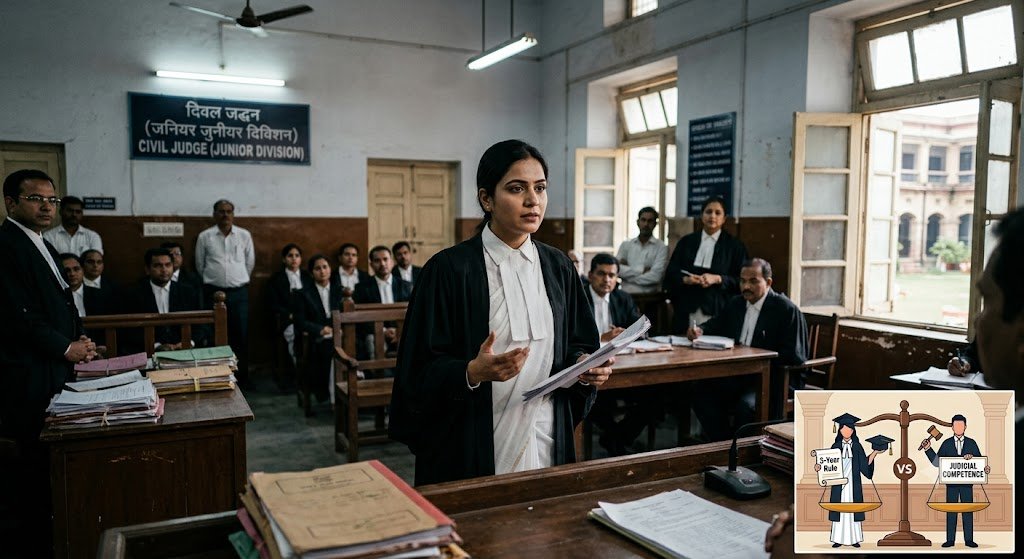
In All India Judges’ Association v. Union of India, the Supreme Court has restored the active practice of law for three years stipulation for becoming eligible to be appointed as a Civil Judge (Junior Division). It’s believed by supporters to be crucial to developing courtroom maturity.
But critics say that it imposes needless restrictions that hinder gender diversity and keep low-attaining fresh graduates away. This article is a well-balanced policy analysis from a gender perspective. It discusses its genesis, its impact in practice, its constitutional legality, and its usefulness in creating a better path forward for law students, judicial hopefuls and defenders of an inclusive judicial system. The 3-Year Rule was introduced, suspended, and reinstated by the Enforcement of the Ordering Rule.
2. Rise, Relaxation, and Reintroduction of the 3-Year Rule
Legal Background
The question traces back to the early 1990s when the Supreme Court emphasised experience in practice for the judiciary officers. The requirement was subsequently relaxed after the recommendations of the Shetty Commission to recruit young people.
Key Judicial Development
The Supreme Court on 20 May 2025 Judgment (All India Judges’ Association v. Union of India, 2025 INSC 735) had directed the High Courts and State Governments to modify service rules. The candidates must have at least three years of experience (from provisional enrolment with the State Bar Council) which will include law clerk experience. Judges too are required to complete a minimum of one year of training before conducting cases. The rule shall take effect on its next recruitment.
Relevant Provisions
- Articles 233 and 234 of the Constitution (appointment of district judges and subordinate judiciary).
- State Judicial Service Rules (as per directions of the Supreme Court).

3. The Systemic Hurdle – Disproportionate Impact on Women
There are special challenges in the unstructured three-year Bar apprenticeship:
- Financial Vulnerability: Stipends in junior chambers are either low or none, making it difficult for families to make ends meet.
- Women are disproportionately affected by safety and infrastructure concerns, including long working hours, unsafe transportation and inadequate court facilities.
- Societal Pressures: Marriage and Family Schedules are often in conflict with the demands of a Litigation Practice.
- Networking Barriers: Chambers of which are male dominated, thus reducing opportunities for mentoring.
The rule is a socio-economic filter, rather than just a merit-based one, because of these factors.
4. Voices from the Bench and Academia
This is a summary of the CNLU Address Voices from the Bench and Academia. While Supreme Court Justice B.V. Nagarathna gave his thought on the matter during an event at Chanakya National Law University, Patna, Vice-Chancellor Prof. (Dr.) Faizan Mustafa gave his contrasting perspective.
Justice Nagarathna said that Bar experience is a vital component in the development of courtroom skills and maturity for women aspirants, saying that it is not a disincentive to women. Prof. Mustafa emphasized that the rule may actually be a ‘backlash’ to reservations for
women in judicial services, as it may end up excluding their more capable female candidates from the pool due to the harsh conditions of the legal profession.In their exchange, two basic tensions arise: the need to be competent and to have access to resources.
5. Comparative Analysis
Impact of the proposed laws on gender representation
| Aspect | States Allowing FreshGraduates (Pre-2025) | States with Strict PracticeRequirement |
| Women Representation (Lower Judiciary) | Higher entry-level increases (e.g., ~30-38% inprogressive states) | Lower diversity increases |
| Talent Pool | Broader access for recentgraduates | More experienced butpotentially narrower pool |
| Challenges | Smaller amount of hands-onexperience at first | Socio-economic issues,particularly for women |
National data indicates that in recent years, women make up about 37% of the judiciary, with higher numbers of women at the lower-level where direct recruitment was available. The uniform national rule may lead to the standardization of barriers.
6. Article 14 and 15(3) – Constitutional Scrutiny
The Constitution is alive in students’ mind: Article 14 and 15(3). The rule needs to meet the test of reasonable classification and need to have a rational nexus to the stated objective (judicial competence). It may be arbitrary, critics say, without good empirical evidence that three years (as opposed to structured alternatives) is the right point. Affirmative action is allowed under Article 15(3) (Special Provisions for Women). The rule is apparently neutral, but it may have an adverse impact on women because it does not address gender-specific barriers, which could undermine the intent of improving the diversity of the judiciary.
Petitions challenging the rule are still being considered with the Court raising the point on the effect of the rule on women candidates.
7. An Alternative to Superior: Compulsory Judicial Training
The Law Commission of India’s 118th Report (On Method of Appointing Subordinate Courts) recommended for the reinforcement of recruitment and training models. A better approach:
- Through stringent testing, choose desirable students.
- Send them through a structured judicial academy program over a 1-2 year period (classroom instruction, mentorship, simulated trials, ethics).
- Safe and supportive skill building prior to independent adjudication.
This is a model for competence, and not one that involves disparities in private Bar experiences.
8. Practical Implications
For Aspirants (particularly women):
- Make careful notes as a law clerk or certified practice.
- Join paid chambers or clerkships, or women’s networks.
- Follow up petitions and notifications of extension and modification in the Supreme Court.
- Have a solid academic and co-curricular record as a hedge.
For the Judiciary: A more experienced cohort could have greater efficiency during trials, but could face the prospect of not having enough talent and slower diversity.
Common pitfalls to avoid: Making unsubstantiated “practices” without the proper certification; delaying applications due to uncertainty.
Suggested Multimedia:
- Infographic: Timeline of the 3-Year Rule.
- Table that compares state outcomes (as above).
- Flowchart showing the pre- and post-2025 recruitment pathway.
9. Frequently Asked Questions
- Is there a limit to how many years of law clerk experience can be counted toward the 3 years?
Answer: Yes, as explained in the 2025 judgment.
- Will the rule be changed for women or for fresh graduates?
Answer: Petitions are pending and the Court has raised gender impact concerns but there is no final change.
- Do states have the option to have different rules?
Answer: The Supreme Court gave orders for uniformity in recruitment in the future.
- What do current graduates need to do?
Answer: Begin to gain some real-life experience as quickly as possible and keep abreast of progress.
10. Key Takeaways
On 20 May 2025, the Supreme Court restored the 3-year practice rule for Civil Judges (Junior Division) keeping in view the requirement of practical competence. The rule poses legitimate equity concerns, especially for female aspirants who must deal with structural limitations.
Key legal provisions: Articles 14, 15(3), 233–234; All India Judges’ Association v. Union of India (2025).
Institutional training academies provide a balanced alternative. Relevant experience and continuous evaluation of progress should be key points for the aspirant to concentrate on.
11. Conclusion
The 3-year litigation practice rule is a good faith attempt to fortify the lower courts with experience. As is, though, it may be an unintended gatekeeper that inhibits diversity particularly women. The system could end up losing out on highly skilled candidates who would flourish if given the right supports if it focuses on Bar time rather than structured, institutionalised training.
As review petitions are being heard, the approach can be improved, ensure competence and representation. A more diverse judiciary will provide more empathetic and effective justice. Aspirants: remain resilient, keep a record of your journey, and continue to engage with these developing standards! It is a crucial part of the bench of the future.
References
- All India Judges’ Association v. Union of India (20 May 2025, 2025 INSC 735) Supreme Court of India. On indiankanoon.org/ or SCI website.
- The 118th report of the Law Commission of India on Method of Appointment to Subordinate Courts, 1986-87. Available on lawcommissionofindia.nic.in.
Get Your Article Published with Lawleaf – Submit an article Here.
Excellent piece, Mansi! Your research skills truly shine through the way you’ve balanced the Supreme Court’s 2025 judgment rationale on courtroom competence with the real equity concerns is impressive. Thoroughly researched, nuanced, and thought-provoking. This is exactly the kind of informed discourse we need on judicial reforms. Keep up the great work!
Well researched and important article! The 3-year litigation rule risks becoming a gatekeeper against diversity. It hits women, rural, and first-gen lawyers hardest due to financial and societal pressures, even as lower judiciary diversity improved with direct entry. Practical experience matters, but extended judicial training could achieve the same without excluding talented young graduates. Hope the review petitions lead to a balanced solution.
Best wishes for your future endeavours.