Introduction
The Supreme Court student protests petition seeking judicial intervention into alleged police excesses during the “Sansad Chalo” march was turned down for urgent listing on Wednesday, July 22, 2026. Heading a bench alongside Justices Joymalya Bagchi and V. Mohana, Chief Justice of India (CJI) Surya Kant declined an expedited hearing or viewing video recordings offered by counsel.
Heading a bench alongside Justices Joymalya Bagchi and V. Mohana, Chief Justice of India (CJI) Surya Kant declined to grant an expedited listing or view video recordings offered by the petitioner’s counsel as evidence of police violence. Responding to the oral mentioning, the CJI remarked, “Don’t waste our time, and don’t waste your time.”
The decision has sparked intense discussion across legal and civil rights circles regarding the handling of public interest litigation (PIL) during oral mentioning hours, as well as the court’s strict separation between procedural protocols and video evidence.
What Transpired in the Supreme Court Student Protests Hearing?
During the morning mentioning session—a designated period where advocates request early dates for pressing cases—Advocate Narendra Mishra presented a letter petition urging the apex court to take suo motu cognisance of police action during the July 20 protest march organized by the Cockroach Janata Party (CJP).
Key Details of the Courtroom Exchange:
- Plea for Urgent Intervention: The counsel emphasized that the petition concerned systemic issues affecting lakhs of students across the country, including allegations surrounding the NEET examination paper leaks, structural reforms in the National Testing Agency (NTA), and the demanded resignation of Union Education Minister Dharmendra Pradhan.
- CJI’s Initial Reaction: As the counsel requested a hearing for the following day, CJI Surya Kant cut the submission short, observing: “Don’t waste our time, and don’t waste your time.”
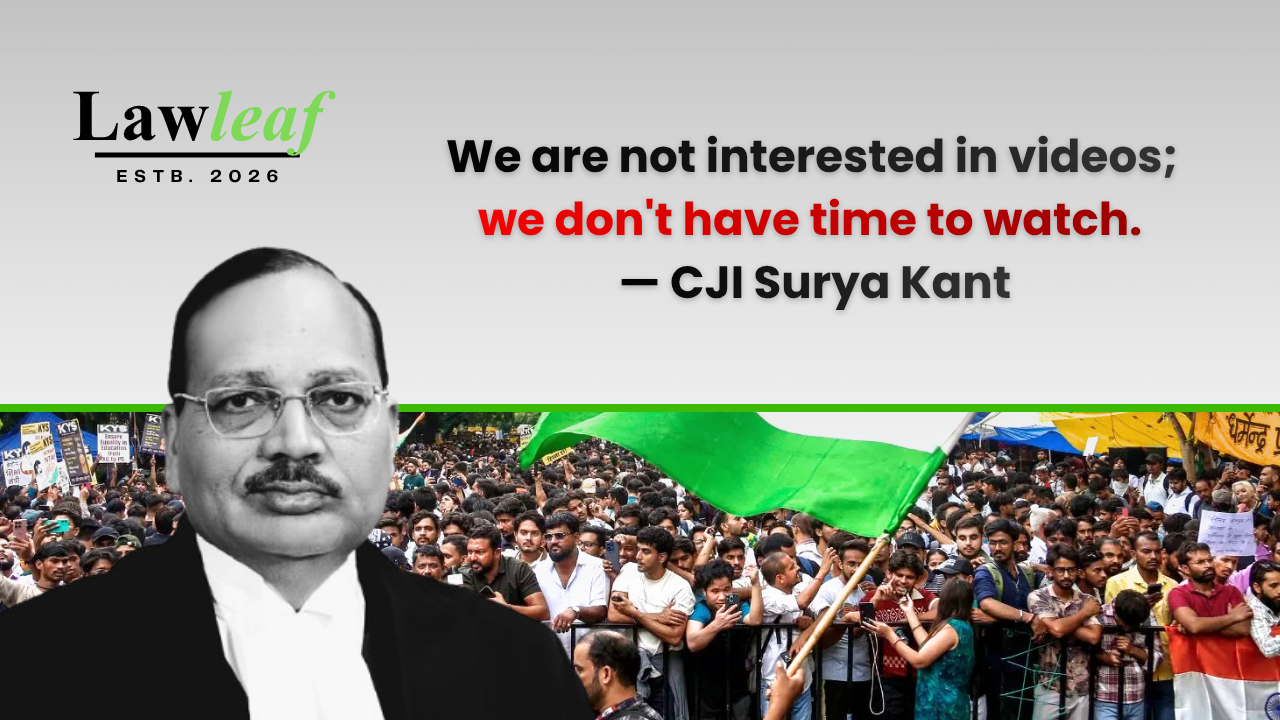
- Submission of Video Footage: When the advocate offered to present videos showing security forces deploying lathis and tear gas against demonstrators, the bench firmly declined:“We are not interested in videos; we don’t have time to watch.” — CJI Surya Kant
The petition sought several remedies, including:
- A court-monitored, independent inquiry into the police action.
- Directives to register FIRs against security personnel involved in targeted violence.
- Financial compensation for injured student demonstrators.
- Immediate orders to preserve electronic evidence and CCTV footage surrounding Jantar Mantar and Parliament House.
Also Read: Neet Examination Paper Leak
Background: The CJP Parliament March & Timeline
The legal dispute surrounding the Supreme Court student protests stems from the July 20 “Chalo Sansad” march, which marked a major escalation following a month-long sit-in at Jantar Mantar led by the CJP alongside climate activist Sonam Wangchuk and various student organizations.
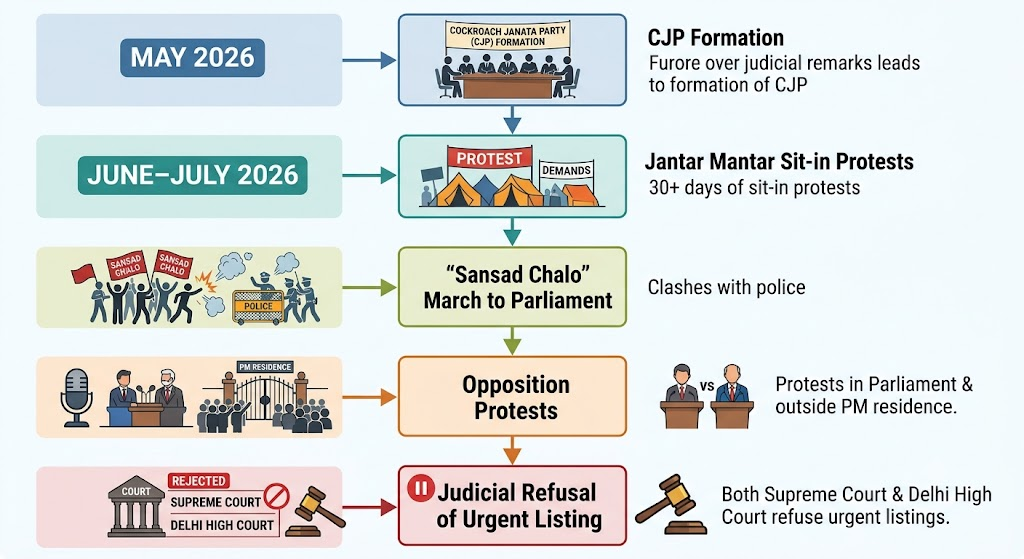
On the opening day of Parliament’s Monsoon Session, thousands of student activists attempted to march towards the Parliament complex. Security forces deployed multiple layers of barricades, tear gas, and baton charges to disperse the crowd after groups breached barriers. Hospitals in Delhi reported treating dozens of individuals for physical trauma, head injuries, and lacerations, while the Delhi Police reported that over 60 police personnel were injured in clashes.
Judicial & Legal Community Reactions
The apex court’s refusal to grant an urgent listing follows a similar stance taken by the Delhi High Court, where a division bench led by Chief Justice Devendra Kumar Upadhyaya declined an oral request for urgent circulation, remarking, “Don’t drag the court into all this.”
Meanwhile, official bar bodies have raised concerns regarding the incident:
- Supreme Court Bar Association (SCBA): Adopted a resolution expressing serious concern over reports of police force used against demonstrators and members of the legal fraternity, demanding a time-bound, impartial inquiry.
- Supreme Court Advocates-on-Record Association (SCAORA): Reaffirmed that peaceful assembly is protected under Article 19 of the Constitution and emphasized that any restriction must satisfy legal requirements of proportionality and necessity.
As discussions regarding the Supreme Court student protests grew, official bar bodies and legal associations raised serious concerns over the reported actions taken against demonstrators:
Legal & Public Implications
The courtroom exchange highlights two competing views within the legal system:
- Procedural Norms & Evidence: Legal experts point out that the Supreme Court maintains a strict distinction between standard evidentiary procedures and oral mentioning. Courts generally require verified affidavits, structured pleadings, and regular listing queues rather than raw video files presented during brief mentioning sessions.
- Fundamental Rights & Urgency: Opponents in the Supreme Court student protests debate argue that when allegations involve widespread police brutality or state overreach, the court’s constitutional mandate as a custodian of fundamental rights justifies swift intervention, irrespective of docket pressure.
Key Takeaway
While the Supreme Court upheld its procedural hierarchy by refusing an expedited hearing via oral mentioning, the substantive petition remains subject to the regular filing and listing process. As public interest in the CJP demonstrations remains high, attention turns to how the higher judiciary will address the underlying legal and constitutional questions when the matter is formally listed for hearing.
Also Read: Article 19 of the Constitution
Leave a Reply