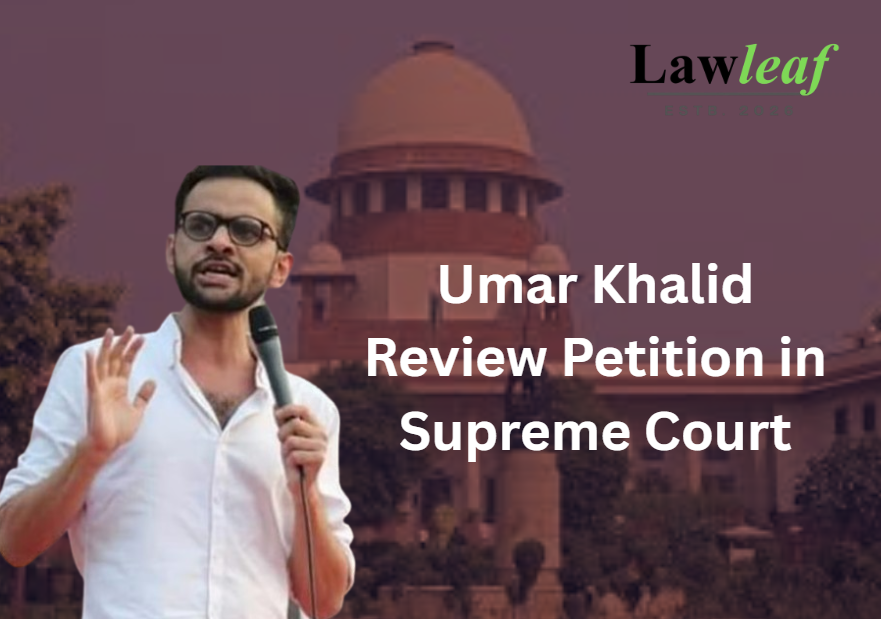
In a significant legal development, Umar Khalid has filed a review petition in the Supreme Court of India, challenging the court’s January 5, 2026 order that denied him bail in the 2020 Delhi Riots larger conspiracy case. The petition was mentioned before a Bench led by Justice Aravind Kumar on April 13, 2026, by Senior Advocate Kapil Sibal, who sought an open court hearing in the matter.
Justice Kumar noted that he would consider the request and look into the papers. The case, filed through Advocate N Sai Vinod, marks the latest chapter in what has become one of the most closely watched UAPA bail matters in India’s recent legal history.
Background: The 2020 Delhi Riots and the Larger Conspiracy Case
The February 2020 Delhi Riots erupted during widespread protests against the Citizenship Amendment Act (CAA). The violence — concentrated in North-East Delhi — claimed 53 lives, left hundreds injured, and caused extensive destruction of property.
The case in question, FIR No. 59/2020, alleges that a group of student activists and intellectuals hatched a pre-planned conspiracy to orchestrate the riots. Delhi Police charged Umar Khalid, Sharjeel Imam, and over a dozen others as alleged “masterminds” of this conspiracy.
Khalid, a former research scholar at Jawaharlal Nehru University (JNU) and former leader of the Democratic Students’ Union, was arrested on September 13, 2020. He has been lodged in Tihar Jail since then — well over four and a half years — without charges having been framed against him in the trial court.
Charges Against Umar Khalid
Khalid faces an extensive set of charges spanning multiple statutes:
Under the Bharatiya Nyaya Sanhita / IPC:
– Criminal conspiracy
– Rioting (Sections 147, 148)
– Unlawful assembly (Section 142)
– Murder (Section 302)
– Promotion of enmity between groups (Section 153A)
– Sedition (Section 124A — now deleted under BNS)
Under the Unlawful Activities (Prevention) Act, 1967 (UAPA):
– Section 13 — Unlawful activities
– Section 16 — Terrorist act
– Section 17 — Raising funds for a terrorist act
– Section 18 — Conspiracy for terrorist act
Under the Arms Act, 1959:
– Sections 25 and 27 — Illegal arms possession and use
It is worth noting that in December 2022, a Karkardooma Sessions Court acquitted Khalid in a separate case involving rioting, vandalism, and property damage in the Khajuri Khas area. He has nonetheless remained in custody under the broader conspiracy charges.
Five Accused Granted Bail
The Court granted bail to Gulfisha Fatima, Meeran Haider, Shifa Ur Rehman, Shadab Ahmed, and Mohd Saleem Khan. The Court noted that their alleged roles were peripheral rather than central to the conspiracy. Given the prolonged pre-trial incarceration and delays in trial, the Court held that their continued detention would be disproportionate to constitutional principles.
The Bench observed: “The petitioners are not shown to be prime movers of the alleged conspiracy and have been in custody for an extended period without trial; continued detention at this stage would be disproportionate.”
Bail Denied to Khalid and Imam
For Umar Khalid and Sharjeel Imam, the Court concluded differently. Applying Section 43D(5) of the UAPA, which requires denial of bail if the court is satisfied that the accusation is prima facie true, the Bench held that the prosecution material disclosed a prima facie case against both.
The Court placed them on a “qualitatively different footing” from the other accused, describing Khalid and Imam as the alleged “principal architects” of the conspiracy.
The Court also stated that the delay in trial was not “solely” attributable to the prosecution or the courts and that the “seriousness of the offence” could be weighed in the balance. Crucially, the Court left a window open: Khalid and Imam were permitted to file fresh bail applications upon completion of examination of protected witnesses or after one year from the date of the order.
Key Arguments Advanced by the Defence
Throughout the extended bail hearings — spanning 11 days of arguments before the Supreme Court — Senior Advocate Kapil Sibal made several pointed submissions for Khalid:
On Physical Absence from Delhi: Khalid was not in Delhi when the riots broke out on February 23-26, 2020. His only overt act cited by the prosecution is a speech he delivered in Amravati, Maharashtra on February 17, 2020 — more than a week before the violence.
On the Nature of the Speech: The Amravati speech, played in open court, invoked Mahatma Gandhi and the principle of non-violent civil disobedience. Sibal argued: “Advocating Gandhian civil disobedience cannot be treated as a conspiracy under the UAPA.”
On Parity: Three co-accused — Asif Iqbal Tanha, Devangana Kalita, and Natasha Narwal — were granted bail by the Delhi High Court in 2021. Sibal argued before the Supreme Court: “Those three were present in Delhi on the day of riots. They are granted bail. I was not even in Delhi. And I am denied bail!”
On Trial Delay: Sibal documented the staggering delays before the Supreme Court — the presiding judge of the trial court was on leave for 55 dates, the matter could not be taken up for 26 dates due to paucity of time, and the Special Public Prosecutor was unavailable on 59 dates.
On No Material Recovery: No weapons, funds, or incriminating materials were recovered from Khalid. Out of 751 riot-related FIRs, Khalid was named in only one.
What Is a Review Petition? The Legal Framework
Grounds for Review
The grounds for maintainability of a review petition are narrow. The Court may review an order if:
1. New and important matter or evidence has come to light which, after the exercise of due diligence, was not within the knowledge of the petitioner
2. There is an error apparent on the face of the record
3. There is any other sufficient reason analogous to those specified above
Review petitions are ordinarily heard by the same judges who delivered the original judgment, typically through circulation (without oral arguments). An open court hearing — which Sibal specifically sought — is the exception, not the rule, and is granted only in extraordinary cases.
Significance of Seeking Open Court Hearing
The request by Sibal for an open court hearing is legally significant. It signals that the defence believes there are substantive errors of law in the January 5 order that warrant oral arguments, not merely a paper review. Courts have, in landmark cases, permitted open court hearings in review petitions where constitutional questions or grave injustice is alleged.
Section 43D(5) UAPA: The Bail Standard at the Centre of the Controversy
At the heart of every bail denial in this case is Section 43D(5) of the UAPA, which reads:
“Notwithstanding anything contained in the Code of Criminal Procedure, 1973, no person accused of an offence punishable under Chapters IV and VI of this Act shall, if in custody, be released on bail… if the Court, on a perusal of the case diary or the report made under section 173 of the Code is of the opinion that there are reasonable grounds for believing that the accusation against such person is prima facie true.”
This provision has been the subject of sustained judicial and academic debate. In NIA v Zahoor Ahmad Shah Watali (2019), the Supreme Court held that at the bail stage, courts must only conduct a “broad and preliminary” review of the prosecution material — not a detailed analysis of evidence on merits. This low threshold has made bail extremely difficult to obtain in UAPA cases.
Critics point out that in Union of India v K.A. Najeeb (2021), a three-judge Bench of the Supreme Court had held that prolonged incarceration without trial can itself provide grounds for bail even under the UAPA, by engaging the right to speedy trial under Article 21. The January 2026 judgment’s reliance on the two-judge Bench ruling in Gurwinder Singh v State of Punjab (2024) — which disfavoured bail in UAPA matters — over the three-judge Najeeb ruling has drawn sharp criticism from legal commentators.
Critical Reception of the January 2026 Bail Order
The Supreme Court’s decision to deny bail to Khalid and Imam while granting it to five others has attracted significant commentary.
Legal commentators have noted the “eyes wide shut” approach — a phrase used to describe courts accepting prosecution material at face value under Section 43D(5) without meaningful scrutiny of its reliability or plausibility.
Questions have also been raised about the role-based differentiation principle applied by the Court — namely, why Khalid, who was absent from Delhi during the riots, was categorised as a “principal architect” while those allegedly present received bail. The distinction drawn between conducting a “dharna” (sit-in protest) and a “chakka jam” (blockade) as the line separating lawful protest from a terrorist conspiracy has particularly drawn comment from constitutional law scholars.
International bodies have also weighed in. Multiple UN Special Procedures mandate holders have called for Khalid’s release, expressing concern about the UAPA’s overbroad definition of “terrorist act” and its impact on civil society, student activists, and journalists.
What Happens Next?
The review petition is currently listed before a Bench led by Justice Aravind Kumar. If the Court grants an open court hearing as sought by Sibal, there will be an opportunity for substantive oral arguments on the alleged errors in the bail denial order.
If the review petition is dismissed, Khalid’s next option would be a curative petition — an even more exceptional remedy available in rare circumstances. Alternatively, as the Supreme Court itself noted in January 2026, Khalid can apply for fresh bail after examination of protected witnesses in the trial is completed, or after one year from January 5, 2026 — i.e., from January 2027 onwards.
The trial itself, before the Additional Sessions Court at Karkardooma, remains at an early stage with arguments on charges not yet complete.
Key Takeaways
- Umar Khalid, arrested in September 2020 under the UAPA in the Delhi Riots conspiracy case, has filed a review petition before the Supreme Court challenging his January 2026 bail denial
- Senior Advocate Kapil Sibal mentioned the petition before Justice Aravind Kumar on April 13, 2026, seeking an open court hearing
- The Supreme Court’s January 5, 2026 order denied bail to Khalid and Sharjeel Imam while granting it to five co-accused
- The Court applied Section 43D(5) of the UAPA, finding prima facie allegations against Khalid and Imam that placed them on a “qualitatively different footing”
- The defence argues Khalid was absent from Delhi during the riots, no material was recovered, and the only overt act cited is a speech invoking Gandhian principles
- The case raises pressing constitutional questions about the balance between national security legislation, personal liberty, and the right to a speedy trial
Conclusion
Umar Khalid’s review petition brings into sharp focus some of the most difficult constitutional questions in Indian law today — the scope of UAPA bail provisions, the right to personal liberty under Article 21, the meaning of “terrorist conspiracy” in the context of political protests, and the role of courts in providing meaningful review of prolonged incarceration.
With over four and a half years of pre-trial custody behind him and trial yet to commence, the petition represents a last-resort attempt to secure relief through review of the same court’s order. Whether the Supreme Court will take the unusual step of hearing the matter in open court will itself be a significant signal.
For legal professionals and scholars tracking the development of UAPA jurisprudence in India, this case remains essential reading.
Stay updated with Lawleaf for all developments in this case and related UAPA judgments.
FAQs
1. What is the review petition filed by Umar Khalid in the Supreme Court?
Umar Khalid has filed a review petition under Article 137 of the Constitution challenging the Supreme Court’s January 5, 2026 order that denied him bail in the 2020 Delhi Riots larger conspiracy case under the UAPA. Senior Advocate Kapil Sibal sought an open court hearing before a Bench led by Justice Aravind Kumar.
2. Why was Umar Khalid denied bail in January 2026?
A Bench of Justices Aravind Kumar and NV Anjaria denied bail to Khalid under Section 43D(5) of the UAPA, holding that the prosecution material disclosed a prima facie case against him. The Court found that Khalid stood on a “qualitatively different footing” from other co-accused who were granted bail, as the material pointed to a central and strategic role in the alleged conspiracy.
3. What is Section 43D(5) of the UAPA and why is it controversial?
Section 43D(5) of the Unlawful Activities (Prevention) Act, 1967 prohibits bail if the court believes, on a perusal of the case diary, that the accusation against the accused is prima facie true. It is controversial because it sets a low threshold — prosecution material is often taken at face value — making bail nearly impossible to obtain. Critics argue it effectively makes pre-trial detention a form of punishment.
4. How long has Umar Khalid been in jail?
Umar Khalid has been in judicial custody since his arrest on September 13, 2020 — over four and a half years as of April 2026. Charges have yet to be framed in the trial court.
5. Can a review petition succeed in overturning a bail denial?
A review petition is maintainable on narrow grounds: new material, an error apparent on the face of the record, or analogous sufficient cause. The threshold for review is high, and the remedy is exceptional. An open court hearing, if granted, would be a significant development as it allows oral arguments on alleged errors.
6. What are the next steps if the review petition is dismissed?
If dismissed, Khalid can file a curative petition before the Supreme Court. He can also file a fresh bail application, as the January 2026 order permits a fresh application upon completion of examination of protected witnesses or after January 2027 — whichever is earlier.