NEET 2026 Telegram Ban Explained: Section 69A of the IT Act and Its Legal Impact
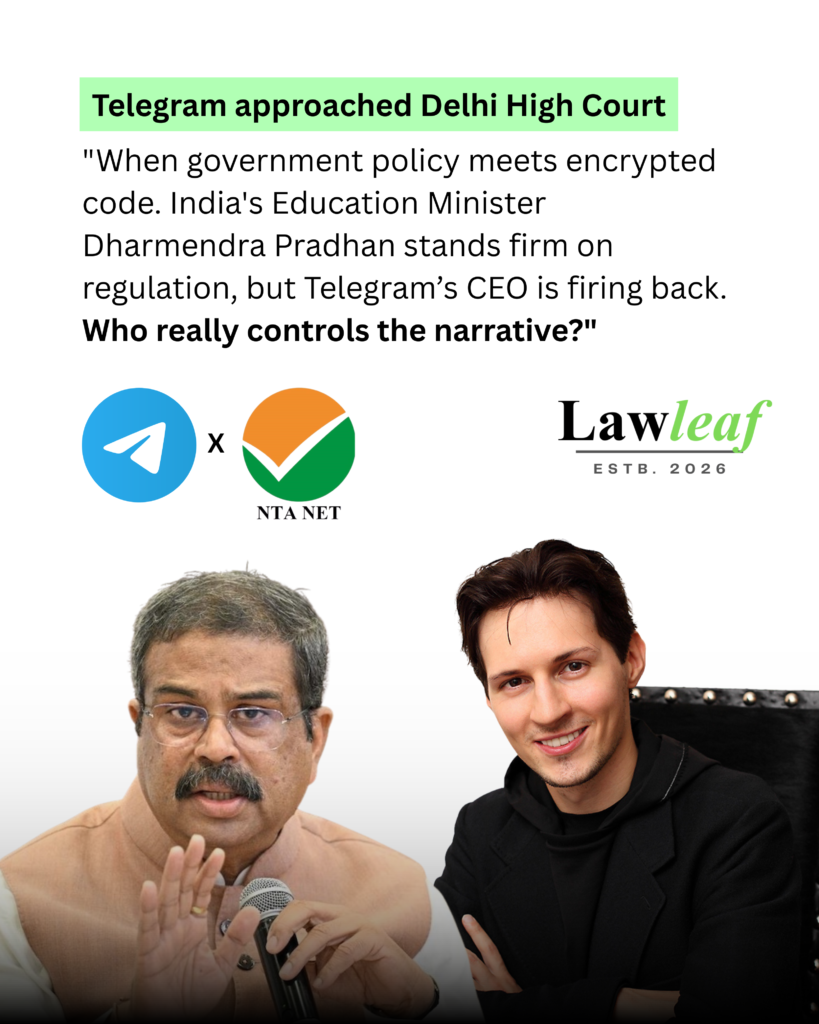
The Core Issue: Telegram, NEET Re-Exam, and the NTA
The Government of India’s decision to temporarily restrict access to Telegram ahead of the NEET (UG) 2026 re-examination has triggered significant discussion on the balance between exam integrity and digital freedoms. With the re-examination scheduled for 21 June 2026, authorities introduced the restriction to curb organized cheating networks and fraudulent paper leak schemes allegedly operating through the messaging platform.
The National Testing Agency (NTA) has supported the move, describing it as a calibrated and time-bound measure intended to safeguard the fairness of the examination process. According to the agency, several Telegram channels claiming to possess the NEET question paper were demanding substantial sums of money from candidates. The NTA has categorically stated that these claims are fraudulent and that no authentic examination paper is available outside its secure distribution chain.
How the Restriction Has Been Structured
The measures introduced by the government are designed to address different forms of misuse associated with the platform.
| Restriction | Duration | Legal Basis | Objective |
|---|---|---|---|
| Temporary restriction on platform access | Until 22 June 2026 | Section 69A of the Information Technology Act, 2000 | To prevent the use of Telegram for organized cheating and fraudulent activities during the NEET re-examination period. |
| Temporary disabling of message-editing functionality | Until 30 June 2026 | Feature-specific government direction | To prevent manipulation of timestamps and fabricated evidence of alleged paper leaks. |
One of the primary concerns highlighted by authorities is the misuse of Telegram’s message-editing feature. Administrators could allegedly edit previously posted messages after the examination to insert leaked PDFs or other materials while retaining the original timestamp, thereby creating the false impression that the content had been shared before the examination commenced.
NEET 2026 Telegram Ban and Section 69A of the IT Act
The government has relied on Section 69A of the Information Technology Act, 2000, which empowers it to direct the blocking of public access to information in certain circumstances, including where it is necessary in the interests of sovereignty, security of the State, public order, or related statutory grounds.
Authorities have justified the temporary restriction as a preventive measure aimed at preserving the integrity of a high-stakes national examination and protecting candidates from fraudulent schemes.
Legal Challenges to the NEET 2026 Telegram Ban
Despite the government’s justification, the decision has attracted criticism from legal experts and digital rights advocates, who argue that a nationwide restriction on an entire communication platform raises important constitutional questions.
1. Scope of Section 69A
Critics contend that Section 69A was designed to permit targeted blocking of specific information or content rather than complete restrictions on platforms used by millions of legitimate users. They argue that extending its application to an entire messaging service may exceed the intended statutory framework.
2. The Principle of Proportionality
A key constitutional concern relates to whether a blanket restriction represents the least restrictive means of achieving the government’s objective. Opponents argue that removing or blocking individual channels involved in fraudulent activities may have addressed the issue without affecting ordinary users who rely on Telegram for education, professional communication, and legitimate collaboration.
3. Balancing Public Interest and Digital Rights
The controversy illustrates the continuing challenge of balancing public order and examination security with citizens’ access to digital platforms. While preventing examination fraud is a legitimate governmental objective, broad restrictions inevitably affect users who have no connection with unlawful activities.
How the NEET 2026 Telegram Ban Affects Students
The temporary restriction has had significant consequences for thousands of students who use Telegram as an educational resource. Many candidates depend on the platform for:
- Access to study materials and notes.
- Participation in doubt-clearing groups.
- Receiving coaching updates and announcements.
- Collaborating with peers in preparation for competitive examinations.
For these users, the restriction has resulted in temporary disruption just days before an important national examination. Nevertheless, authorities maintain that the measure is necessary to combat organized scams and protect the credibility of the examination process.
NTA’s Position on Paper Leak Claims
The National Testing Agency has repeatedly clarified that claims circulating online regarding access to genuine NEET question papers are false. Candidates are advised not to pay money to individuals or groups promising examination papers or guaranteed admissions, as such offers are fraudulent and intended to deceive aspirants.
The agency has also encouraged students to rely only on official communications and verified sources for examination-related information.
Read Full NTA Press Released – Click Here
Key Takeaways
- The restriction on Telegram was introduced as a temporary measure linked to the NEET (UG) 2026 re-examination.
- General platform access restrictions are expected to remain in place until 22 June 2026, while limitations on message-editing features are intended to continue until 30 June 2026.
- The government has invoked Section 69A of the Information Technology Act, 2000 as the legal basis for the action.
- The NTA maintains that the restrictions are necessary to prevent fraudulent paper leak scams and organized cheating networks.
- Legal commentators have questioned whether a platform-wide restriction satisfies constitutional standards of necessity and proportionality.
- Students are advised to avoid unofficial channels claiming to possess examination papers and to report suspicious activities to the appropriate authorities.
Reporting Fraudulent Activities
Candidates who encounter individuals or groups demanding money in exchange for alleged NEET question papers or other fraudulent promises should immediately report the matter through the National Cyber Crime Helpline by dialing 1930 or by using the government’s official cybercrime reporting mechanisms.
Conclusion
The temporary restriction on Telegram in connection with NEET (UG) 2026 reflects the ongoing tension between protecting the integrity of national examinations and preserving digital freedoms. While authorities view the measure as necessary to combat organized fraud and misinformation, critics argue that broader platform restrictions may raise important questions about proportionality and constitutional safeguards.
As legal and policy discussions continue, the episode serves as a reminder that technological enforcement measures must strike a careful balance between public interest objectives and the rights of millions of legitimate users who depend on digital platforms for education, communication, and professional engagement.
Connect with Lawleaf
Instagram | Linkedin | YouTube Channel | FB Page
Read About Supreme Court AI Regulation here: https://lawleaf.in/supreme-court-ai-regulation-2026-explained/
Leave a Reply