Can Banks Invoke IBC Over Builder-Linked Loans? Supreme Court Says No
Banks often assume that a loan default automatically opens the door to insolvency proceedings. The Supreme Court has now drawn a clear line against invoking IBC when a loan was never really a straightforward lending arrangement. In a recent ruling, the Court held that a bank cannot invoke IBC against a corporate debtor when the loan amount was directly disbursed to a builder and tied to construction milestones rather than to the debtor itself.
This judgment matters for banks, corporate debtors, and insolvency professionals alike. It reshapes how courts will view loans that are structured as part of a larger, multi-party real estate transaction.
Background of the Case
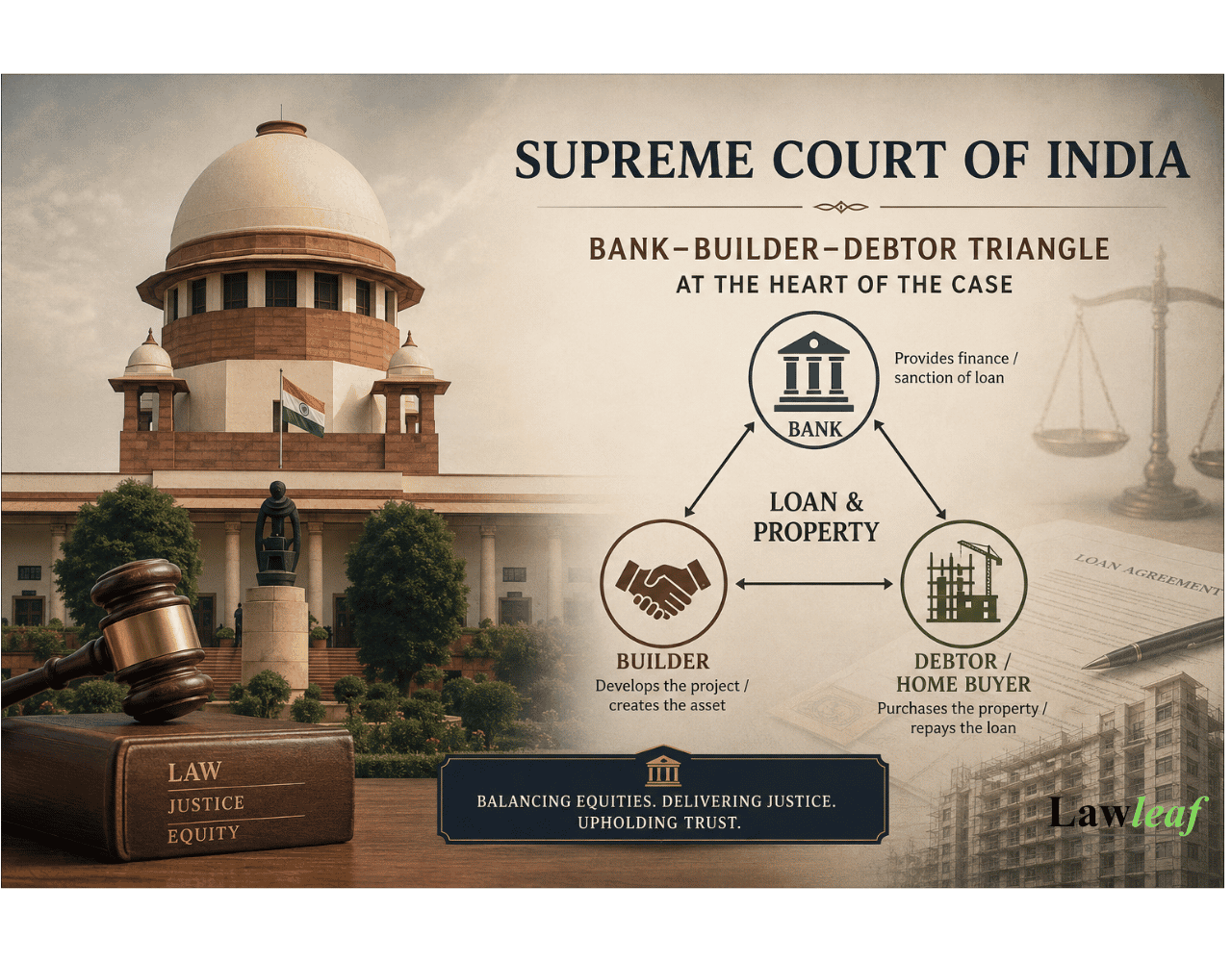
The dispute arose after Dhanlaxmi Bank sanctioned a loan of Rs. 1.34 crore to a corporate debtor for purchasing a property in a builder’s real estate project. However, the bank did not hand over the money to the debtor. Instead, it disbursed the funds directly to the builder, in line with a quadripartite agreement between the bank, the debtor, the builder, and other stakeholders.
Under this arrangement, repayment was closely linked to how the builder progressed with construction, delivery, and transfer of the property. When the debtor’s account turned into a Non-Performing Asset, the bank first approached the Debt Recovery Tribunal. Recovery proceedings began there.
Despite that ongoing recovery process, the bank later initiated winding-up proceedings under the Companies Act. These were subsequently transferred and treated as a Section 7 IBC application, seeking to trigger the Corporate Insolvency Resolution Process, or CIRP, against the debtor.
The NCLT admitted the case, holding that a debt and a default existed. The debtor’s suspended director challenged this before the NCLAT, arguing that the loan structure did not fit the standard definition of financial debt. The NCLAT agreed, and set aside the CIRP order. The bank then approached the Supreme Court.
The Core Legal Question
The central issue before the Supreme Court was narrow but significant. Could a bank invoke IBC against a corporate debtor when the loan was not paid to the debtor directly, but to a builder, with repayment obligations linked to the builder’s own performance?
This question sits at the intersection of insolvency law and contract law. It also touches a recurring concern in Indian insolvency jurisprudence: whether IBC is being used for its intended purpose, or as a shortcut for debt recovery.
What the Supreme Court Held
A bench comprising Justice Pamidighantam Sri Narasimha and Justice Alok Aradhe dismissed the bank’s appeal. Justice Aradhe, authoring the judgment, upheld the NCLAT’s view that this transaction could not be treated as a simple financial creditor-debtor relationship.
The Court reasoned that because the loan amount went straight to the builder, and because the builder carried real obligations around construction and delivery, the bank’s disbursement was tightly linked to the builder’s own performance. That structure meant the dispute was fundamentally contractual in nature, not a plain lending relationship suited to IBC.
Importantly, the Court cautioned against turning insolvency proceedings into a tool for coercive recovery. Where the real objective behind filing a Section 7 IBC application is simply to pressure a party into paying up, rather than to resolve genuine financial distress, that amounts to an abuse of process. On this basis, the appeal was dismissed and the NCLAT’s order was upheld.
Why This Ruling Matters
This decision reinforces a principle that IBC practitioners have been watching closely: not every unpaid loan qualifies as financial debt under the Code. The nature of the transaction, and how the money actually flowed, matters just as much as the loan documentation.
For banks, this ruling is a reminder to think carefully before treating IBC as a recovery mechanism. If a loan is structured around a third party’s performance, such as a builder’s construction timeline, banks may need to pursue civil remedies or contractual enforcement instead of insolvency proceedings.
For corporate debtors, especially those buying property through builder-linked loan arrangements, this judgment offers a layer of protection. It confirms that courts will look past the label of “loan” and examine the substance of the transaction before allowing insolvency proceedings to proceed.
Key Differences: Genuine Financial Debt vs. Builder-Linked Disbursement
| Aspect | Genuine Financial Debt | Builder-Linked Disbursement |
|---|---|---|
| Fund flow | Directly to the debtor | Directly to a third-party builder |
| Repayment trigger | Debtor’s own obligation | Tied to builder’s construction progress |
| Nature of dispute | Purely financial | Largely contractual |
| Suitability for IBC | Generally valid | Questionable, per this ruling |
Key Takeaways
- The Supreme Court held that a bank cannot invoke IBC against a corporate debtor when loan funds were disbursed directly to a builder under a quadripartite arrangement.
- Repayment obligations tied to a builder’s construction performance shift the dispute into contractual territory, outside the scope of straightforward financial debt.
- Using Section 7 IBC applications purely to pressure repayment, instead of resolving real financial distress, amounts to an abuse of process.
- The ruling protects corporate debtors from insolvency proceedings triggered by disputes that are essentially contractual, not financial, in nature.
- Banks and financial institutions should reassess how they structure and enforce builder-linked loan disbursements going forward.
Conclusion
This Supreme Court ruling draws an important boundary around how IBC can be used. It confirms that the Code exists to resolve real financial distress, not to shortcut ordinary contractual disputes involving builders and buyers. For anyone tracking insolvency law in India, this case is worth remembering the next time a builder-linked loan dispute lands in court.
Want more judgment breakdowns like this one delivered straight to your inbox? Subscribe to LawLeaf’s newsletter and stay ahead of every major Supreme Court and NCLAT ruling.
Can a bank invoke IBC against a corporate debtor for a builder-linked loan?
No. The Supreme Court held that IBC cannot be invoked when the loan was disbursed to a builder and repayment was tied to the builder’s construction progress.
What is Section 7 of the Insolvency and Bankruptcy Code?
Section 7 IBC allows a financial creditor to file an application before the NCLT to initiate the Corporate Insolvency Resolution Process against a corporate debtor in default.
Why did the Supreme Court dismiss the bank’s appeal in this IBC case?
The Court found that the transaction was fundamentally contractual, since the bank’s disbursement to the builder was linked to the builder’s own performance obligations, not a straightforward loan to the debtor.
What does “abuse of process” mean in the context of IBC proceedings?
It refers to using insolvency proceedings, meant to resolve genuine financial distress, purely as a tool to pressure a party into repayment, which courts have repeatedly discouraged.
Leave a Reply