The BCI Social Media Circular 2026 sets new rules for advocates, interns & law students. Discover the 7 crucial compliance points before you post.
Table of Contents
- Introduction
- What Is the BCI Social Media Circular 2026?
- Why Was the BCI Social Media Circular 2026 Issued?
- Legal Basis of the BCI Social Media Circular 2026
- Conduct Advocates Must Avoid
- Special Rules Under the BCI Social Media Circular for Law Students and Interns
- What Is Still Allowed
- New Compliance and Oversight Mechanisms
- Consequences of Violating the Circular
- Practical Compliance Checklist
- Key Takeaways
- Conclusion
- FAQs
BCI Social Media Circular 2026: The Complete Guide for Advocates, Interns & Law Students
The BCI Social Media Circular 2026 has changed the digital conduct rules for every member of the Indian legal fraternity, effective 17 July 2026. If you’re an advocate, law student, or intern, this circular directly affects what you can and cannot post online.
This guide breaks down the entire circular — its legal basis, restrictions, and consequences — in plain, actionable language.
What Is the BCI Social Media Circular 2026?
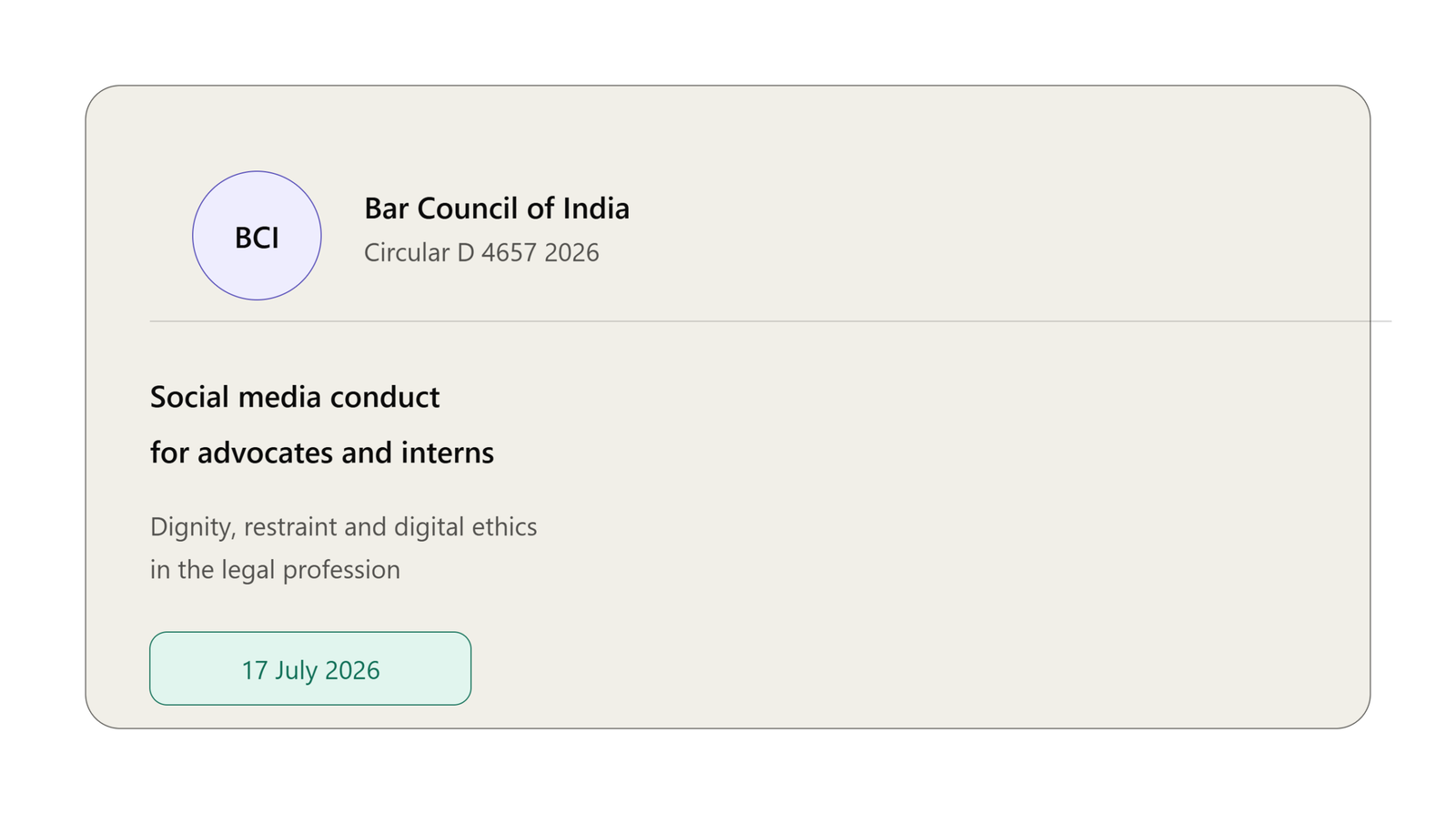
The BCI Social Media Circular 2026 (Circular No. BCI:D:4657/2026) is a formal directive from the Bar Council of India. It governs how advocates, law students, and interns may use social media in relation to Courts, judges, and legal work.
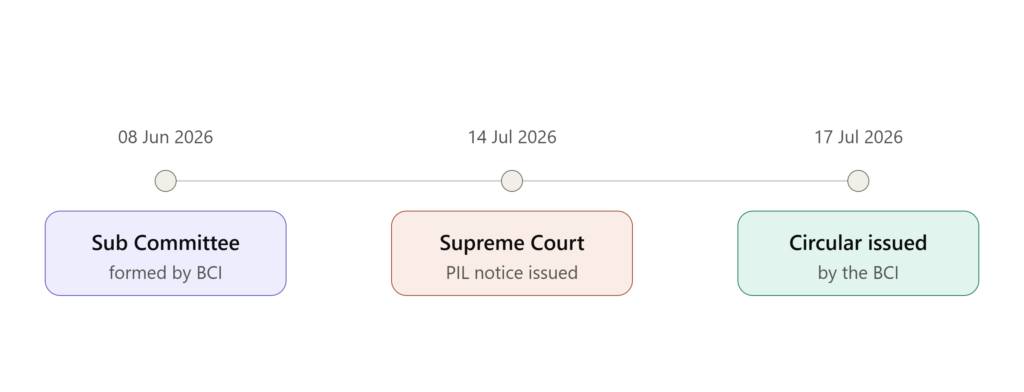
The circular was issued in the backdrop of a pending Supreme Court PIL, Anil Pandey v. Bar Council of India, and a BCI Sub-Committee report examining digital misconduct in the profession. It is signed by Srimanto Sen, Principal Secretary, Bar Council of India.
Importantly, this is not vague moral guidance. The BCI social media circular is expressly rooted in the Advocates Act, 1961, and the Bar Council of India Rules — meaning violations can trigger real disciplinary consequences.
Scope of the BCI Social Media Circular
The circular applies broadly across the profession, including:
- All enrolled Advocates and Senior Advocates
- Law students, interns, and research scholars
- Chambers, law firms, and internship coordinators
- State Bar Councils and Bar Associations
- Centres of Legal Education (law colleges and universities)
Why Was the BCI Social Media Circular 2026 Issued?
The Bar Council of India noted a disturbing rise in reels, vlogs, and dramatic clips shot inside courtrooms and chambers. Selectively edited live-streamed proceedings, often with mocking captions, were also flagged as a serious concern.
Legal misinformation compounded the problem. Unqualified “legal influencers” were found circulating fake judgments, fabricated citations, and misleading legal advice online.
A Kerala High Court Bar Association circular on the same subject, combined with the pending Supreme Court petition, pushed the BCI to formalize a nationwide response through this circular.
Legal Basis of the BCI Social Media Circular 2026
The circular draws its authority from specific statutory provisions rather than informal advisory power. Understanding this legal foundation is essential to grasping why compliance is non-negotiable.
Key statutory anchors include:
- Section 7(1)(b) — power to lay down standards of professional conduct
- Section 7(1)(d) — power to safeguard advocates’ rights and interests
- Section 49(1)(c) — rule-making power over professional conduct
- Section 35 — disciplinary action for professional misconduct
See Bar Council of India Official Website
The circular also references the Information Technology Act, 2000, the Digital Personal Data Protection Act, 2023, and the Bharatiya Sakshya Adhiniyam, 2023 — particularly regarding AI-generated content, deepfakes, and confidentiality.
See Ministry of Law and Justice, Government of India
Conduct Advocates Must Avoid
The BCI social media circular identifies a long list of prohibited digital behaviour. At its core, the test is whether content uses the Court, a client matter, or professional identity to gain personal or commercial advantage.
Advocates should refrain from:
- Making reels, vlogs, or promotional content inside Court premises
- Clipping or editing live-streamed hearings with mocking or sensational captions
- Using robes, bands, or chamber settings as social media “props”
- Indirect advertising, solicitation, or clickbait guarantees like “guaranteed bail”
- Disclosing confidential client, case, or chamber information online
- Creating or circulating AI-generated, deepfake, or voice-cloned content involving judges or Courts
Each of these points ties back to existing duties under Chapter II, Part VI of the Bar Council of India Rules — dignity, restraint, confidentiality, and the prohibition on advertisement under Rule 36.
Why the BCI Social Media Circular Treats AI Content Seriously
Synthetic and AI-manipulated content received specific attention in this circular. Fake judgments, fabricated cause lists, and deepfake videos of judges are treated as aggravated breaches.
This reflects a broader regulatory trend: AI misuse in the legal space is increasingly being addressed through existing professional conduct frameworks rather than waiting for new legislation.
Also Read: Is AI good for India?
Special Rules Under the BCI Social Media Circular for Law Students and Interns
Interns and law students face particularly detailed obligations. The BCI made clear that internships exist for learning, not content creation.
Students and interns must not:
- Post “day in Court” or “day in chamber” reels and vlogs
- Record hearings, client meetings, or internal chamber discussions
- Use internship access for personal branding or follower growth
- Disclose case files, pleadings, or research assignments online
A mandatory written undertaking is now required before every internship begins. Centres of Legal Education must also obtain a separate undertaking at the time of course admission.
Seniors, chambers, and law firms are expected to brief every new intern on day one about these restrictions. This shifts part of the compliance burden onto institutions, not just individual students.
What Is Still Allowed
The BCI social media circular does not ban legal content altogether. Genuine legal education and academic commentary remain fully permitted.
Advocates and students may continue:
- Academic discussion of judgments and legal principles
- Neutral, accurate case-law updates
- Short-form legal education (reels, carousels) if non-promotional
- Disclosing enrolment number and State Bar Council for transparency
The dividing line is intent and framing. Content that educates the public is welcome; content that markets the creator or trivializes the Court is not.
New Compliance and Oversight Mechanisms
To make the circular enforceable in practice, the Bar Council of India has introduced a layered institutional structure. This is arguably the most significant operational change in the entire document.
The framework includes:
- State Bar Council Digital Ethics Committees to receive and review complaints
- BCI Digital Ethics Nodal Cell to liaise with social media platforms
- Online complaint portals for reporting offending content
- Graded breach classification — minor, serious, and aggravated
Each State Bar Council is expected to designate a Social Media Ethics Nodal Officer. This officer counsels first-time violators and escalates repeated or serious violations to the competent disciplinary authority.
Standalone Affidavits Under the BCI Social Media Circular
New entrants to the profession will need to execute a standalone sworn affidavit at the stage of enrolment. This affidavit specifically acknowledges digital conduct obligations, separate from the general enrolment form.
This design choice matters. Burying the obligation inside a routine form, the BCI noted, would not command sufficient attention from new advocates.
Consequences of Violating the Circular
Violations of the BCI social media circular are not treated uniformly — the response depends on the severity and repetition of the conduct. Minor, first-time lapses typically attract counselling or a request for deletion.
Serious or aggravated breaches carry heavier consequences, including:
- Disciplinary proceedings under Section 35 of the Advocates Act, 1961
- Reporting to the concerned Court, Registry, or platform
- Contempt, civil, or criminal action where applicable
- Withdrawal of internship or reporting to the Centre of Legal Education
- Mandatory deletion, correction, or public apology
The circular is careful to state that no adverse action can be taken without a fair, proportionate process. Due opportunity of explanation remains guaranteed under principles of natural justice.
Practical Compliance Checklist
Before your next post about a hearing, chamber day, or legal opinion, run through this quick checklist drawn from the BCI social media circular.
- Does the content reveal any confidential client or case detail?
- Does it use Court premises, robes, or signage as a backdrop?
- Does it promise outcomes (“guaranteed bail,” “sure acquittal”)?
- Is any AI-generated or synthetic element clearly disclosed?
- Would a reasonable viewer see this as advertising or solicitation?
If the answer to any of these is “yes,” the safest course under the BCI social media circular is to revise or withhold the content entirely.
Key Takeaways
- The BCI Social Media Circular 2026 is legally binding, not just advisory guidance.
- It prohibits Court-premises content, solicitation, and AI-generated deepfakes.
- Interns must sign undertakings before every internship placement.
- Genuine legal education content remains permitted and even encouraged.
- Violations can trigger disciplinary proceedings under Section 35 of the Advocates Act.
Conclusion
The BCI Social Media Circular 2026 marks a decisive shift in how the Indian legal profession approaches digital conduct. For advocates, interns, and law students alike, understanding these rules is no longer optional — it’s essential professional hygiene.
Staying compliant protects not just your career, but the dignity of the Bar as a whole. Bookmark this guide and revisit it before your next court-related post.
FAQs
1. What is the BCI Social Media Circular 2026?
It is a formal directive from the Bar Council of India regulating social media conduct for advocates, law students, and interns, issued on 17 July 2026.
2. Does the BCI Social Media Circular ban all reels and videos?
No. It permits genuine legal education content but prohibits promotional, sensational, or Court-premises content.
3. Are law students required to sign an undertaking under this circular?
Yes, a written undertaking is mandatory before admission and before every internship placement.
4. Can advocates disclose their enrolment number on social media?
Yes, this is permitted for transparency purposes but must not be used as advertisement or solicitation.
5. What happens if an advocate violates the BCI Social Media Circular?
Consequences range from counselling and content deletion to disciplinary proceedings under Section 35 of the Advocates Act, 1961.
6. Does the circular cover AI-generated or deepfake content?
Yes, creating or circulating AI-generated, deepfake, or voice-cloned content depicting judges or Courts is expressly prohibited.
Leave a Reply