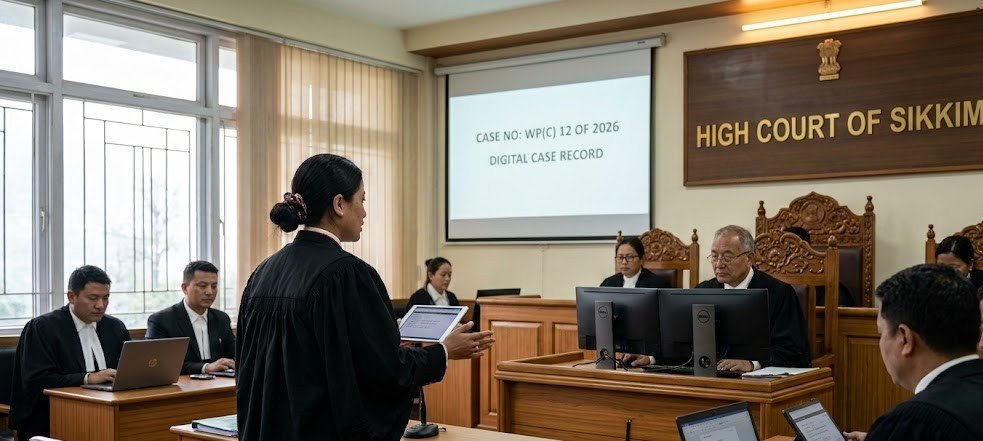
How e-Courts, AI-powered tools, and geographic necessity converged to transform a Himalayan state’s justice delivery system
Table of Contents
1. Introduction
2. Legal Background: The e-Courts Mission Mode Project
3. The Infrastructure Shift: From Paper Trails to Digital Portfolios
4. Bridging the Terrain Divide: Geography as a Constitutional Problem
5. AI as a Force Multiplier: SUPACE, SUVAS, and Judicial Efficiency
6. Practical Implications: What Sikkim’s Model Means in Real Terms
7. Roadblocks to a Nationwide Paperless Model
8. Frequently Asked Questions
9. Key Takeaways
10. Conclusion
1. Introduction
On 1 May 2026, Chief Justice of India Surya Kant stood at Chintan Bhawan in Gangtok and declared what many in India’s legal establishment had considered a distant ambition: Sikkim had become the country’s first fully paperless state judiciary. The announcement, made during the National Conclave on Technology and Judicial Education organised by the High Court of Sikkim in collaboration with the eCommittee of the Supreme Court of India, was not simply a technology milestone. It was a constitutional statement about what access to justice under Article 21 must look like in a mountainous frontier state where, not long ago, a litigant’s day in court meant days of travel across narrow Himalayan paths.
The declaration coincided with Sikkim’s 50th Statehood Anniversary, and the symbolism was deliberate. Half a century after Sikkim joined the Indian Union, its judiciary had completed a transition from physical paper records to an end-to-end digital system: e-filing, digital case records, virtual hearings, automated workflows, and AI-assisted research tools. Every court process, from the filing of a first petition to the delivery of a judgment, now runs without paper.
This article examines how Sikkim got there, what the digital infrastructure actually looks like on the ground, and what the honest obstacles are to replicating the model across India’s 25 other states and union territories.
2. Legal Background: The e-Courts Mission Mode Project
Sikkim’s paperless judiciary did not emerge from a single policy decision. It is the culmination of nearly two decades of phased digital reform driven by the e-Courts Mission Mode Project, a central government initiative conceived in 2005 on the basis of a national policy document prepared by the eCommittee of the Supreme Court of India.
The project has proceeded in three phases. Phase I and Phase II, completed through 2024, focused on computerising district and subordinate courts, installing broadband connectivity, establishing the National Judicial Data Grid (NJDG) as a real-time repository of case data across all computerised courts, and enabling basic e-filing and online fee payment. By the close of Phase II, close to 95 percent of Indian courts had achieved near 100 Mbps bandwidth speeds, and the NJDG had become, in CJI Surya Kant’s words, the “beating heart” of the judiciary’s performance tracking.
Phase III, running from 2023 to 2027 and approved by the Union Cabinet with an outlay of Rs 7,210 crore, takes the project substantially further. Its core objectives are end-to-end digitisation of all court interactions, universal e-filing, digitisation of legacy paper records, AI integration for scheduling and case prioritisation, and the creation of a unified national technological platform. Within this allocation, Rs 53.57 crore is specifically earmarked for AI and blockchain integration across High Courts. Sikkim’s achievement represents the first complete implementation of Phase III’s paperless court vision at the state judiciary level.
The constitutional anchor for this project is Article 21, which the Supreme Court has consistently interpreted to include the right to speedy and effective access to justice. In Hussainara Khatoon v. State of Bihar (1979), the Court held that the right to a speedy trial is a fundamental right flowing from Article 21. Subsequent judgments have expanded this to encompass access to courts as a precondition for the exercise of any fundamental right. A paperless judiciary, by eliminating geographical and procedural barriers, is a direct institutional response to this constitutional mandate.
3. The Infrastructure Shift: From Paper Trails to Digital Portfolios
What does a paperless judiciary actually look like in operational terms? In Sikkim’s courts, it means that the entire lifecycle of a case, from first filing to final disposal, runs on digital infrastructure.
Filing and Registration: Petitions, plaints, and applications are filed electronically through the e-filing platform. Physical submission is no longer required or accepted for new matters. The system automatically assigns case numbers, generates receipts, and routes matters to the appropriate bench.
Case Records: Physical files and paper-bundled documents have been replaced by unified digital portfolios. Judges access case records, pleadings, evidence, and prior orders through secure digital case management systems. The transition required the conversion of legacy physical records into digital formats, a resource-intensive exercise involving scanning, optical character recognition, and metadata tagging.
Hearings: Virtual hearing infrastructure, expanded significantly during the COVID-19 period, is now a standard feature rather than an emergency measure. Litigants and advocates in remote districts of Sikkim can appear before courts via video conferencing, removing the need to travel to Gangtok for each listing.
Orders and Judgments: All orders and judgments are issued digitally and uploaded to the NJDG, making them publicly accessible in near real-time. The old practice of waiting days or weeks for a certified copy of an order has been replaced by direct digital access.
Automated Workflows: Routine administrative tasks within the registry, such as cause list generation, date assignment, defect notices, and intimation to parties, are managed through automated systems. This reduces the clerical workload substantially and accelerates the movement of cases through the system.
| Paper-Based System | Paperless System (Sikkim Model) |
| Physical filing at court registry | Electronic filing via e-filing portal |
| Bulk paper files moved between courts | Digital case portfolios on secure servers |
| Physical attendance for every hearing | Virtual hearings via video conferencing |
| Manual cause list preparation | Automated scheduling and cause list generation |
| Delayed access to orders and judgments | Instant digital upload to NJDG |
| Clerical file management by court staff | Automated workflow routing within registry |
4. Bridging the Terrain Divide: Geography as a Constitutional Problem
To understand why Sikkim was the right laboratory for this experiment, it is necessary to appreciate what geography means for justice delivery in the northeastern states. CJI Surya Kant put it directly in his inaugural address at the Gangtok conclave: for a Sikkimese litigant seeking justice a decade ago, distance was not measured in kilometres but in days of travel across narrow paths and unpredictable weather. The Himalayas, magnificent as they are, make movement slow and uncertain.
North Sikkim, in particular, is characterised by high-altitude terrain, monsoon landslides, and road conditions that routinely make travel to Gangtok impossible for days at a time. For a litigant with a matter listed before the High Court, every adjournment meant another expensive, physically taxing journey. For witnesses in criminal trials, repeated appearances caused income loss and logistical hardship that often led to non-appearance, which in turn delayed cases.
The paperless model addresses this not through sympathy but through structural change. Virtual hearings allow a litigant in North Sikkim to appear before a judge in Gangtok without stepping outside their district. Digital filing means a petition can be submitted from a smartphone or a computer at a Common Service Centre without requiring the litigant to visit the registry physically. Case status and orders are accessible online, removing the need for court visits merely to obtain procedural information.
The constitutional dimension here is significant. In M.C. Mehta v. Union of India, the Supreme Court recognised that the right to justice cannot be formal or theoretical; it must be practical and effective. Where geography makes physical access prohibitively difficult, the state’s obligation under Article 21 extends to removing those barriers through institutional means. Sikkim’s paperless judiciary is, in this sense, not a technology upgrade but a constitutional compliance measure.
CJI Surya Kant observed at the conclave that digital reform is recalibrating the power dynamics of the courtroom, allowing litigants in remote areas to track case progress, view orders without intermediaries, and engage counsel from across the country via video conferencing. This shift from physical presence as a prerequisite for justice to digital access as its vehicle is the core constitutional argument for the paperless model.
5. AI as a Force Multiplier: SUPACE, SUVAS, and Judicial Efficiency
The paperless infrastructure in Sikkim’s courts is supported by artificial intelligence tools developed under the e-Courts project. CJI Surya Kant specifically highlighted two at the Gangtok conclave: SUPACE and SUVAS. Understanding what these tools do, and what they deliberately do not do, is essential for an accurate picture of AI’s role in Indian courts.
5.1 SUPACE: Research Assistance Without Autonomous Decision-Making
The Supreme Court Portal for Assistance in Court Efficiency (SUPACE) is an AI-based assistive tool designed to help judges manage the information demands of complex matters. Using machine learning and natural language processing, SUPACE extracts relevant facts, identifies applicable legal provisions, and surfaces relevant precedents from the vast body of Indian case law. It does not recommend outcomes. It does not draft orders. Its function is entirely research-oriented, helping judges focus on legal reasoning rather than on the administrative task of sifting through hundreds of pages of case records.
As of early 2026, SUPACE has been piloted primarily in select criminal matters before the Bombay High Court and the Delhi High Court. Its expansion is constrained not by software capability but by hardware requirements: the deep learning models that power SUPACE require high-grade GPUs and TPUs. Under Phase III, Rs 53.57 crore has been allocated for AI and blockchain integration, which includes funding for the hardware and infrastructure needed to scale SUPACE deployments.
5.2 SUVAS: Linguistic Access as a Justice Imperative
The Supreme Court Vidhik Anuvaad Software (SUVAS) addresses a different but equally serious barrier to justice: language. The majority of Indian citizens do not read English fluently, yet until recently, the authoritative text of Supreme Court and High Court judgments was available only in English. SUVAS translates judicial documents between English and scheduled Indian languages, operating on the open-source Anuvaad platform with a human-in-the-loop review process where trained experts, including retired judges and senior law clerks, verify and refine AI-generated translations.
By the end of 2023, SUVAS had translated over 31,000 Supreme Court judgments, with figures continuing to rise through 2025. In early 2026, the system was integrated with Bhashini, the National Language Translation Mission, expanding its access to wider linguistic datasets while maintaining a specialised judicial vocabulary. For Sikkim, which has significant populations speaking Nepali, Sikkimese, and Lepcha, the availability of judgments in accessible languages is a material improvement in the real-world operability of the right to justice.
It is important to note that both SUPACE and SUVAS are designed as assistive tools. Article 348(1)(a) of the Constitution mandates that English remain the authoritative language for High Court and Supreme Court proceedings. SUVAS operates within this constitutional constraint, providing access to translated versions without displacing the English original. Similarly, SUPACE assists but does not replace judicial reasoning.
6. Practical Implications: What Sikkim’s Model Means in Real Terms
For different categories of stakeholders, the practical implications of a paperless judiciary break down as follows.
For Litigants
The most immediate benefit is the elimination of compulsory physical attendance for routine hearing dates. A litigant in a remote village no longer needs to lose a day’s wages, hire transport, and brave uncertain road conditions to attend a procedural listing. E-filing means petitions can be submitted without a trip to the court registry. Real-time case tracking through the NJDG means information that previously required a visit to the court office is accessible from any device.
For Advocates
Digital case files mean advocates can prepare for hearings without accessing physical bundles. Virtual hearings allow counsel registered in one city to appear before courts in another, expanding the pool of legal representation available to litigants in Sikkim. This is particularly significant for specialist matters, such as commercial disputes or constitutional petitions, where domain-specific expertise may not be locally available.
For Judges and Court Administration
Automated workflows reduce the clerical burden on court staff and the administrative load on judges. AI-assisted research tools reduce the time judges spend on information retrieval, theoretically freeing more time for substantive legal analysis. The NJDG provides administrators with real-time data on pendency, disposal rates, and adjournment patterns, enabling evidence-based court management.
For the Environment
The elimination of paper-based processes has an environmental dimension that is often underappreciated in legal discourse. Indian courts have historically consumed enormous quantities of paper through physical files, certified copies, process summons, and court records. A fully paperless system eliminates this consumption entirely at the court level, contributing meaningfully to environmental sustainability goals.
7. Roadblocks to a Nationwide Paperless Model
CJI Surya Kant was clear at the Gangtok conclave that the mission is not yet complete. The Sikkim model, while a genuine milestone, reflects conditions that do not uniformly exist across the country. Three structural challenges stand between Sikkim’s achievement and a nationwide replication.
7.1 The Digital Divide and the Role of e-Sewa Kendras
Litigants in poor, rural, or elderly demographics may lack access to devices, internet connectivity, or the digital literacy needed to use e-filing portals and virtual hearing platforms. A paperless system that assumes smartphone ownership or broadband access effectively excludes the populations most dependent on the courts for the enforcement of their rights.
The institutional response to this is the e-Sewa Kendra, a physical-digital bridge where trained operators assist litigants with digital processes. As of 2026, 48 e-Sewa Kendras exist within High Courts nationally, and 2,283 in district courts. However, for a fully paperless judiciary to be constitutionally acceptable, coverage cannot be patchy. Every litigant who lacks digital access must have a physical access point within reasonable reach. In a country with over 600,000 villages, the current network of e-Sewa Kendras is far from adequate.
7.2 Legacy Record Digitisation
Sikkim’s paperless transition required converting decades of physical court records into digital formats. This is a time-consuming, expensive, and error-prone process. In larger states with far greater volumes of pending and historical cases, the digitisation of legacy records represents a substantial infrastructural challenge. Incomplete digitisation creates a two-tier system where some cases are digital and others remain paper-based, undermining the uniformity that a paperless court requires.
7.3 Cybersecurity and Data Privacy
Digital court records contain highly sensitive personal, financial, and criminal information about litigants, witnesses, and accused persons. A fully digital judiciary is only as secure as its data infrastructure. India does not yet have a comprehensive data protection regime specifically covering judicial data, and inadequate cybersecurity could expose individuals to privacy violations that are, in themselves, violations of the right to privacy recognised in K.S. Puttaswamy v. Union of India (2017). As the paperless model scales, robust data security frameworks must accompany the technological transition.
8. Frequently Asked Questions
What exactly does a ‘paperless judiciary’ mean?
It means that all court processes, including filing of cases, documentary submissions, hearings, orders, and judgments, are conducted digitally. No physical paperwork is required at any stage. Courts in Sikkim now operate entirely through e-filing systems, digital case records, virtual hearings, and automated administrative workflows.
Does this affect ongoing cases, or only new filings?
The transition covers both. Legacy physical records have been digitised and migrated to the digital case management system. New cases are filed, processed, and adjudicated entirely within the digital infrastructure from the outset.
Can a litigant without a smartphone or internet access still approach the court?
Yes, through e-Sewa Kendras, which are physical assistance centres where trained operators help litigants complete digital processes. The system is designed to ensure that lack of personal digital access does not bar a citizen from the court. However, the adequacy of e-Sewa Kendra coverage remains a work in progress nationally.
Is AI being used to decide cases?
No. AI tools like SUPACE assist judges with research and information retrieval. SUVAS translates judgments into regional languages. Neither tool makes decisions, recommends outcomes, or plays any role in the adjudicatory process itself. Decision-making authority remains entirely with the judge.
Will other states follow Sikkim’s model?
The Supreme Court has indicated that the Sikkim model is intended to serve as a benchmark for replication across states under Phase III of the e-Courts project. However, the scale and complexity of replication will vary significantly. States with larger caseloads, lower digital infrastructure, and greater rural populations will require more extensive investment and a longer transition timeline.
9. Key Takeaways
- On 1 May 2026, CJI Surya Kant declared Sikkim as India’s first fully paperless state judiciary at the National Conclave on Technology and Judicial Education in Gangtok.
- The declaration is grounded in the constitutional right to access justice under Article 21, which the Supreme Court has consistently held includes the right to speedy, effective, and accessible courts.
- The paperless system covers the complete lifecycle of a case: e-filing, digital case records, virtual hearings, automated workflow, and real-time NJDG-accessible orders and judgments.
- Sikkim’s geographic terrain, with remote high-altitude districts where travel to court was measured in days, made it an ideal and necessary first site for this transformation.
- AI tools SUPACE (research assistance for judges) and SUVAS (multilingual judgment translation) are integrated into the digital ecosystem as assistive, not autonomous, instruments.
- Phase III of the e-Courts Mission Mode Project (2023-2027) is backed by a Rs 7,210 crore allocation, with Rs 53.57 crore specifically earmarked for AI and blockchain integration.
- Key challenges to nationwide replication include the digital divide, the adequacy of e-Sewa Kendra infrastructure, the scale of legacy record digitisation, and the need for a judicial data security framework.
10. Conclusion
Sikkim’s paperless judiciary is a meaningful constitutional achievement dressed up in the language of technology. The real significance of the CJI’s declaration on 1 May 2026 is not that courts now use computers instead of paper. It is that a Himalayan state with some of the most inaccessible terrain in the country has moved from a system where geography was a functional barrier to justice toward one where access is theoretically available to any litigant with a digital connection or a nearby e-Sewa Kendra.
The challenge ahead is replication at scale. Sikkim’s compact geography and relatively small caseload made it a tractable first mover. States like Uttar Pradesh, Bihar, and Maharashtra, with hundreds of millions of people, tens of millions of pending cases, and deeply uneven digital infrastructure, present an exponentially more complex proposition. The honest assessment is that e-Courts Phase III has the ambition and the funding to move in the right direction, but the digital divide, legacy data challenges, and the absence of a judicial data protection framework will need to be addressed systematically before any state can claim what Sikkim has achieved.
For now, Sikkim stands as proof that the paperless court is not theoretical. The constitutional imperative of access to justice and the practical tools of digital governance have, at least in one small northeastern state, finally arrived at the same address.
Authoritative External References
1. High Court of Sikkim / eCommittee, Supreme Court of India: National Conclave on Technology and Judicial Education, Gangtok, May 2026 – https://indialegallive.com/constitutional-law-news/courts-news/cji-declares-sikkim-as-first-fully-paperless-state-judiciary-in-india/
2. Press Information Bureau, Government of India: ‘From Digitisation to Intelligence: How AI is Enhancing Access to Justice in India’ – https://www.pib.gov.in/PressReleasePage.aspx?PRID=2226283
3. Department of Justice / eCommittee Supreme Court of India: e-Courts Phase III Mission Mode Project Policy and Framework – https://doj.gov.in/page/e-courts-mission-mode-project
Get Your Article Published with Lawleaf – Submit an article Here.
Leave a Reply