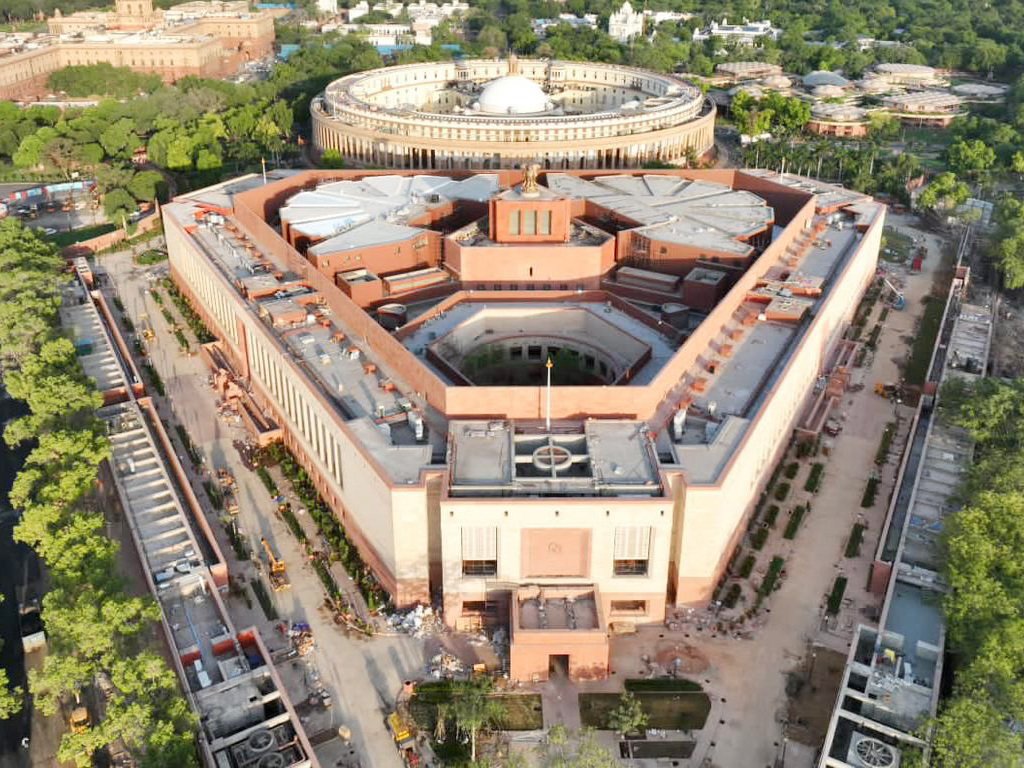
How replacing key ordinances, restructuring higher education, and expanding the Supreme Court bench will define the legislative agenda this monsoon.
Table of Contents
- Introduction
- The Monsoon Session 2026: Key Highlights & Dates
- Major Legislative Business: The 5 New Bills
- Important Pending Bills Up for Passing
- What is an Ordinance? (And Why Two Are Being Replaced)
- Constitutional Rules: The Gap Between Parliament Sessions
- Frequently Asked Questions (FAQ)
- Key Takeaways
- Conclusion
1. Introduction
As the political machinery gears up for the Monsoon Session of Parliament, the legislative docket is stacked with bills that will significantly impact India’s judicial infrastructure, financial regulations, and educational framework. Scheduled to run through July and August 2026, the session is not just about passing new laws; it is also about ratifying crucial executive decisions made during the parliamentary recess.
For legal professionals, advocates, and civil services aspirants, understanding the nuances of these bills alongside the constitutional mechanics of how and when Parliament functionsis essential. This article breaks down the major bills to be introduced, demystifies the ordinance-making power of the President, and explains the constitutional timelines governing parliamentary sessions.
2. The Monsoon Session 2026: Key Highlights & Dates
The Monsoon Session of 2026 is officially scheduled to be held between July 20, 2026, and August 13, 2026.
- Total Sittings: 19 days of legislative business.
- Pending Bills: Currently, there are 28 bills pending in Parliament.
- New Introductions: The government has listed five major bills for introduction, consideration, and passing during this session.
3. Major Legislative Business: The 5 New Bills
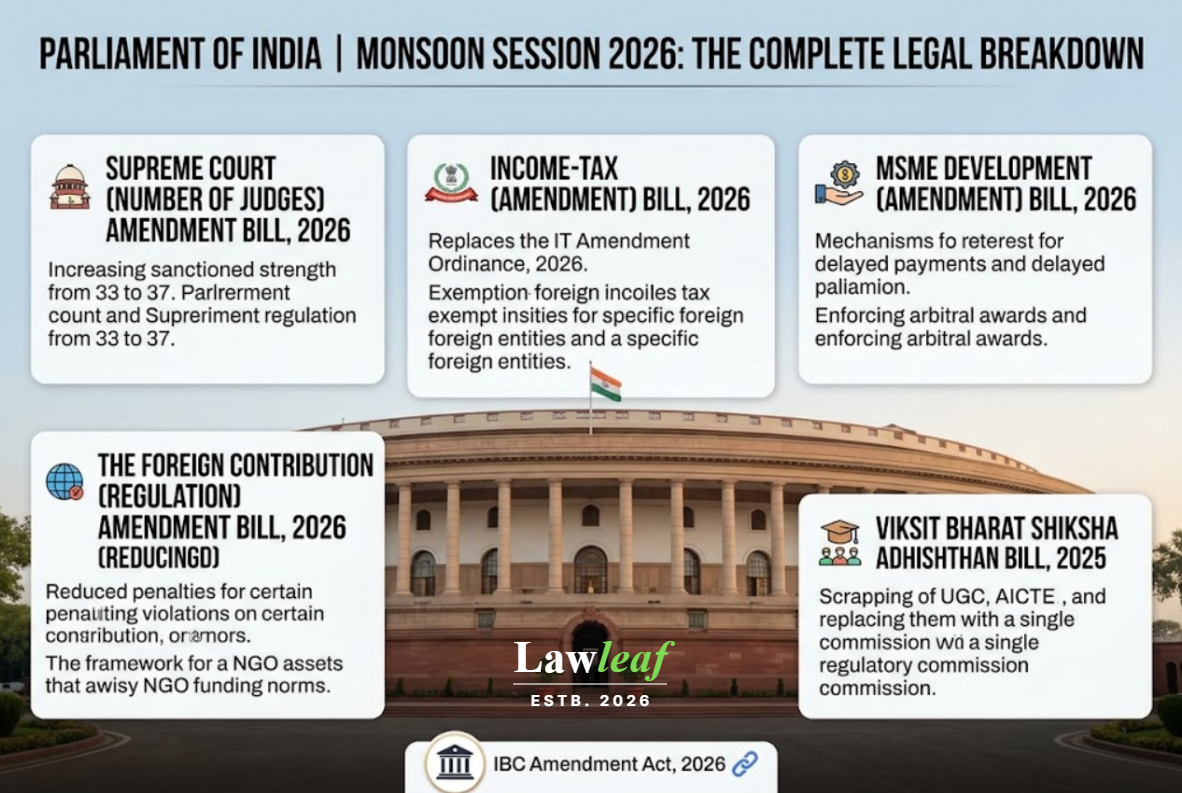
The government has prioritized five new bills for this session. Notably, two of these bills are designed to replace ordinances that were promulgated when Parliament was not in session.
| Short Title | Key Objectives & Legal Impact |
| Supreme Court (Number of Judges) Amendment Bill, 2026 | Replaces a recent ordinance. Seeks to increase the number of Supreme Court judges (excluding the Chief Justice of India) from 33 to 37 to tackle pendency. |
| Income-tax (Amendment) Bill, 2026 | Replaces the IT Amendment Ordinance, 2026. Exempts foreign institutional investors and the Bank for International Settlements from income tax on earnings from government securities. |
| MSME Development (Amendment) Bill, 2026 | Strengthens the legal mechanism to address delayed payments to MSMEs and provides for the strict enforcement of arbitral awards. |
| Registration of Births and Deaths (Amendment) Bill, 2026 | Amends the 1969 Act to make the legal provisions regarding the delayed registration of births and deaths more stringent. |
| Prevention of Insults to National Honour (Amendment) Bill, 2026 | Seeks to amend the 1971 Act, tightening regulations and penalties regarding insults to national symbols. |
4. Important Pending Bills Up for Passing
Aside from the new introductions, Parliament will consider two major pending bills that carry massive implications for NGOs and the education sector:
- The Foreign Contribution (Regulation) Amendment Bill, 2026: Introduced earlier in the Lok Sabha, this bill reduces the maximum penalty for certain FCRA violations from five years to one year. It also establishes a strict framework to manage and dispose of assets of NGOs that lose their FCRA certificates.
- The Viksit Bharat Shiksha Adhishthan Bill, 2025: A monumental shift in education law. This bill seeks to scrap the University Grants Commission (UGC), AICTE, and the National Council for Teacher Education, replacing them with a single, overarching regulatory commission for higher education in India.
Also Read: IBC Amendment Act, 2026
5. What is an Ordinance? (And Why Two Are Being Replaced)
You will notice that two of the major bills this session (Income-tax and Supreme Court Judges) explicitly state they are replacing “Ordinances.” But what exactly does this mean in a constitutional context?
The Constitutional Power:
Under Article 123 of the Constitution of India, the President has the legislative power to promulgate ordinances. This power is exercised only when either of the two Houses of Parliament (Lok Sabha or Rajya Sabha) is not in session, and the President is satisfied that immediate action is necessary.
The Lifespan of an Ordinance:
An ordinance has the exact same legal force and effect as an Act of Parliament. However, it is fundamentally a temporary measure.
- Once Parliament reconvenes, the ordinance must be laid before both Houses.
- It will cease to operate at the expiration of six weeks from the reassembly of Parliament unless it is approved by both Houses earlier.
- If the government wants the law to remain permanent, it must introduce and pass a Bill to replace the ordinance during the session—which is exactly what the government is doing with the IT and Supreme Court Judges bills this monsoon.
6. Constitutional Rules: The Gap Between Parliament Sessions
The timing of the Monsoon Session brings up a frequent constitutional question: How often must Parliament meet?
The Maximum Gap:
Under Article 85 of the Constitution, the President summons each House of Parliament to meet at such time and place as they think fit. However, the Constitution strictly mandates that the maximum gap between two sessions of Parliament cannot exceed six months.
This means that Parliament must meet at least twice a year. If the Budget Session ends in April, the next session must commence before October.
The Minimum Gap:
Interestingly, the Constitution does not prescribe a minimum gap between sessions. The President can summon Parliament mere days after proroguing a previous session if a national emergency or urgent legislative business demands it.
Note on Convention: While the Constitution only requires two sessions, parliamentary convention in India dictates three standard sessions per year: The Budget Session (Feb-May), the Monsoon Session (July-Aug), and the Winter Session (Nov-Dec).
7. Frequently Asked Questions (FAQ)
Q: Can the President issue an ordinance on any subject?
A: No. The President can only issue ordinances on subjects on which Parliament has the power to make laws (the Union List and the Concurrent List). Furthermore, ordinances are subject to the same constitutional limitations as normal legislation, meaning they cannot violate fundamental rights.
Q: Why expand the Supreme Court bench now?
A: With the Supreme Court (Number of Judges) Amendment Bill, 2026, the bench strength will rise to 38 (37 judges + 1 CJI). This is primarily an institutional response to the mounting backlog of cases and the need for more constitution benches to hear critical matters.
Q: Will the Viksit Bharat Shiksha Adhishthan Bill abolish the UGC immediately?
A: If passed, the transition will occur in phases as outlined in the bill, but the ultimate legal consequence is the complete replacement of the UGC and AICTE with a single centralized regulatory body.
8. Key Takeaways
- Legislative Heavyweights: The Monsoon Session will run for 19 sittings, tackling 5 major new bills and reviewing 28 pending ones.
- Judicial Expansion: The Supreme Court is set to get a sanctioned strength of 38 judges (including the CJI) to combat pendency.
- Ordinance Mechanics: Article 123 allows emergency lawmaking, but these laws expire 6 weeks after Parliament reassembles unless ratified—hence the urgent introduction of the IT and Supreme Court amendment bills.
- The 6-Month Rule: Article 85 guarantees that the democratic machinery doesn’t stall, capping the maximum allowable gap between any two parliamentary sessions at six months.
9. Conclusion
The Monsoon Session of 2026 is shaping up to be a transformative period for Indian law. The transition from ordinances to permanent acts, the overhauling of higher education regulation, and the expansion of the apex court are clear indicators of a rapidly evolving legal landscape. For advocates and scholars, staying updated on these structural shifts is not just about general knowledge it is vital for accurate legal practice and compliance in the months ahead.
Leave a Reply